A platform management API is a lightweight custom service interface for maintaining platform configuration and integrations that existing tools do not support. It protects a consistent platform experience while enabling teams beyond the primary platform team to contribute safely to roadmap requirements. section 8.5
Common platform management API responsibilities include:
- Maintain standard namespaces across clusters and provide an interface for teams to create and manage custom namespaces. section 8.5
- Synchronize team membership and authorization settings with systems lacking a suitable identity-provider integration. section 8.5
- Generate recurring synchronization events so configuration can recover from unintended external changes. section 8.5
Team onboarding and synchronization
A teams API can onboard a team, maintain its authoritative record, apply the correct RoleBindings across clusters, and publish sync-team events. An enterprise secret-store team can subscribe to those events and configure its system without requiring every integration to belong to the primary platform team. section 8.5
Figure 8.9 A “teams” API can be the interface to onboard a team and maintain the authoritative database for customer teams. This API will maintain the correct RoleBindings on the respective clusters. It can also populate the “sync team” events stream to which other services can subscribe.
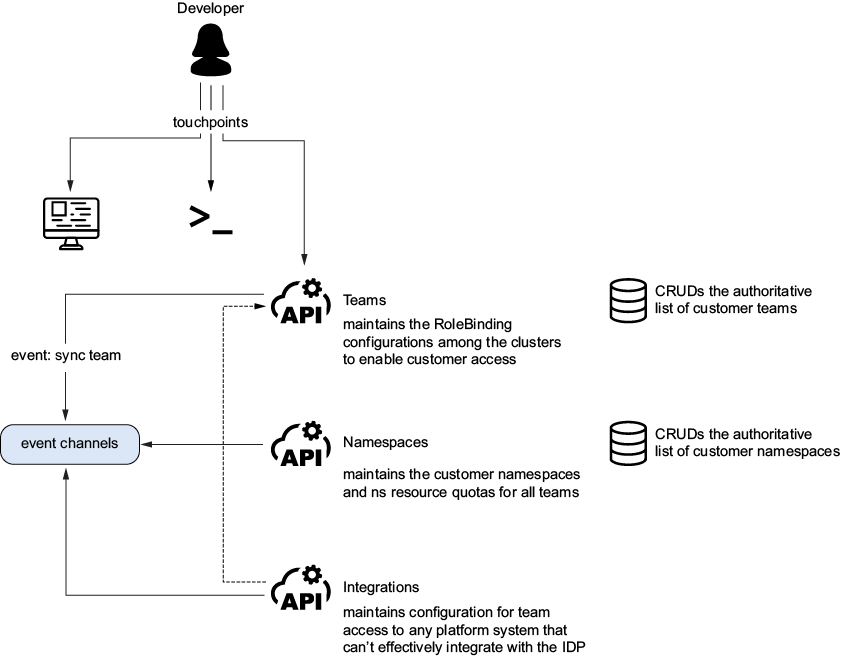
Shows how a teams API combines team onboarding, authoritative configuration, cluster RoleBindings, and an event stream for downstream services. section 8.5
