Channel selection chooses a radio-frequency channel to reduce interference and preserve wireless LAN performance. Neighboring WLANs and devices such as microwaves, cordless phones, and Bluetooth equipment can disrupt transmissions. section 18.1.1
Apply these exam-relevant rules:
- The 2.4 GHz band has significantly overlapping channels, so neighboring access points should use the 1-6-11 or 1-5-9-13 patterns. section 18.2.3
- 802.11b and 802.11g require careful channel selection because they use 2.4 GHz; 802.11a and 802.11ac use 5 GHz. section 18.2.3
- Account for national regulations because permitted radio-frequency use can differ between countries. section 18.1.1
Exam-style selection
When asked which standards need careful channel selection to avoid neighboring-AP interference, select 802.11b and 802.11g: both operate in the overlapping 2.4 GHz band. section 18.2.3
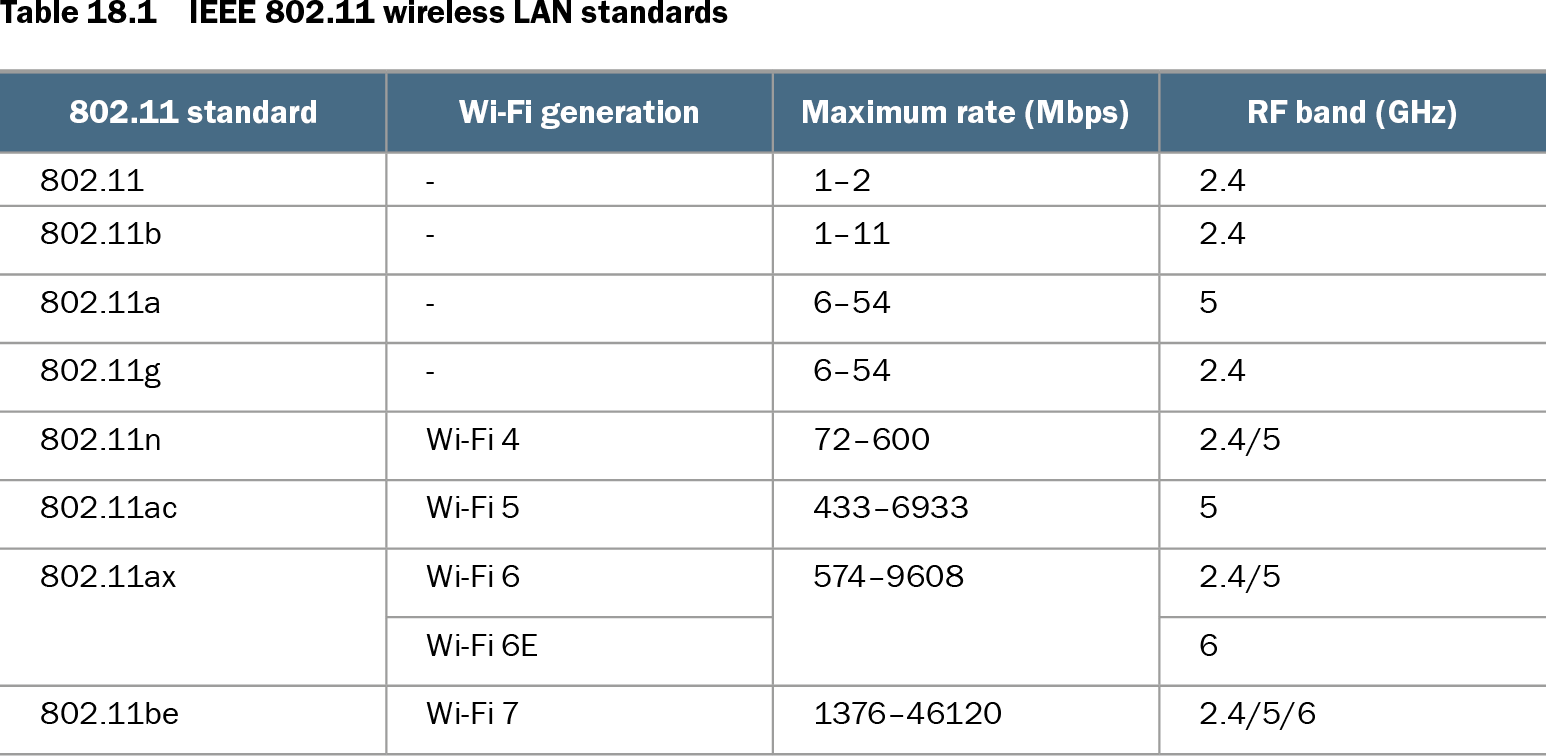
Table 18.1 IEEE 802.11 wireless LAN standards (view table figure)
| 802.11 standard |
Wi-Fi generation |
Maximum rate (Mbps) |
RF band (GHz) |
|---|---|---|---|
| 802.11 |
- |
1–2 |
2.4 |
| 802.11b |
- |
1–11 |
2.4 |
| 802.11a |
- |
6–54 |
5 |
| 802.11g |
- |
6–54 |
2.4 |
| 802.11n |
Wi-Fi 4 |
72–600 |
2.4/5 |
| 802.11ac |
Wi-Fi 5 |
433–6933 |
5 |
| 802.11ax |
Wi-Fi 6 |
574–9608 |
2.4/5 |
| Wi-Fi 6E |
6 |
||
| 802.11be |
Wi-Fi 7 |
1376–46120 |
2.4/5/6 |
Compare each 802.11 standard’s RF band before selecting channels. section 18.2.3