liveBook · Manning

Checklist

As explained in Delivering Machine Learning Projects: From design to deployment

A checklist is a structured list used to verify that required tasks or conditions have been addressed.

A checklist is a structured verification tool for confirming that required work, evidence, documentation, and conditions are complete before a project advances. section 3.4 section 1.4

Use checklists at project checkpoints to reduce omissions and make readiness visible:

  • Pre-project: verify repositories, risk registers, access, and stakeholder review. section 3.4
  • Sprint 0: confirm data descriptions, sources, limitations, business uses, and team conditions. section 4.8
  • Pre-modeling: confirm data access, pipelines, testing, repositories, EDA, baselines, and ethical assessment. section 6.5
  • Post-modeling: confirm feature engineering, model records, experiments, defects, test environments, and reproducibility. section 8.4

Run the checkpoint as a team

Review each item together, require evidence of completion, and let a respected junior team member chair the meeting. This can expose overlooked work before it becomes costly to fix. section 3.4

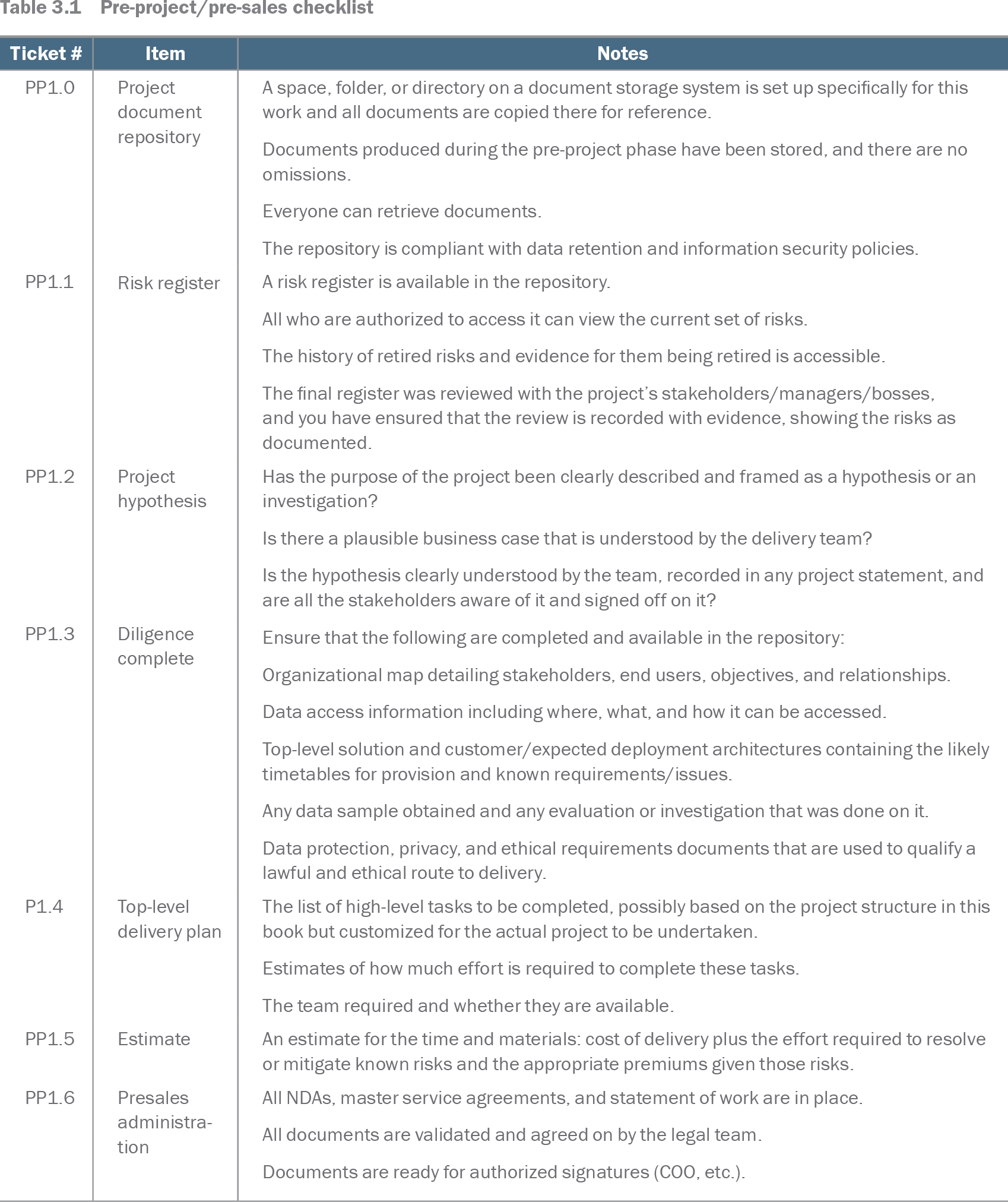
Table 3.1 Pre-project/pre-sales checklist (view table figure)

Ticket #

Item

Notes

PP1.0

Project document repository

A space, folder, or directory on a document storage system is set up specifically for this work and all documents are copied there for reference.

Documents produced during the pre-project phase have been stored, and there are no omissions.

Everyone can retrieve documents.

The repository is compliant with data retention and information security policies.

PP1.1

Risk register

A risk register is available in the repository.

All who are authorized to access it can view the current set of risks.

The history of retired risks and evidence for them being retired is accessible.

The final register was reviewed with the project’s stakeholders/managers/bosses, and you have ensured that the review is recorded with evidence, showing the risks as documented.

PP1.2

Project hypothesis

Has the purpose of the project been clearly described and framed as a hypothesis or an investigation?

Is there a plausible business case that is understood by the delivery team?

Is the hypothesis clearly understood by the team, recorded in any project statement, and are all the stakeholders aware of it and signed off on it?

PP1.3

Diligence complete

Ensure that the following are completed and available in the repository:

Organizational map detailing stakeholders, end users, objectives, and relationships.

Data access information including where, what, and how it can be accessed.

Top-level solution and customer/expected deployment architectures containing the likely timetables for provision and known requirements/issues.

Any data sample obtained and any evaluation or investigation that was done on it.

Data protection, privacy, and ethical requirements documents that are used to qualify a lawful and ethical route to delivery.

P1.4

Top-level delivery plan

The list of high-level tasks to be completed, possibly based on the project structure in this book but customized for the actual project to be undertaken.

Estimates of how much effort is required to complete these tasks.

The team required and whether they are available.

PP1.5

Estimate

An estimate for the time and materials: cost of delivery plus the effort required to resolve or mitigate known risks and the appropriate premiums given those risks.

PP1.6

Presales administration

All NDAs, master service agreements, and statement of work are in place.

All documents are validated and agreed on by the legal team.

Documents are ready for authorized signatures (COO, etc.).

Inspect a ticketed checklist format that pairs each verification item with notes covering repositories, risks, access, retention, and review evidence. section 3.4

How Delivering Machine Learning Projects: From design to deployment covers it

How deep it goes
Details phase-specific verification items and meeting practice, including evidence, repositories, testing, ethical assessment, and reproducibility.
Examples
Uses pre-project, sprint 0, pre-modeling, and post-modeling tables with ticket numbers, notes, and completion evidence.
What it assumes
Assumes an agile project organized around sprints and backlogs, while making phase expectations and documentation requirements explicit.
What you can do after
Apply it to run readiness reviews, expose overlooked work, preserve project evidence, and support iterative correction without losing documentation.
How it connects
Connects sprints, backlogs, risk registers, data pipelines, versioning, exploratory data analysis, model evaluation, documentation, and governance.

Related concepts

This explainer was generated by Manning's knowledge graph from the text of Delivering Machine Learning Projects: From design to deployment. The section links point to the parts of the book it draws on.