Chemistry42 is a drug-design platform for generating and evaluating candidate molecules when conventional starting advantages—such as known selective compounds, a ligand-bound crystal structure, or structure–activity data—are unavailable. section 13.3.1
Its computational workflow combines:
- More than 40 generative models run in parallel. section 13.3.1
- Variational autoencoders represent chemical space continuously, while reinforcement learning searches that space. section 13.3.1
- Multi-objective rewards balance predicted binding affinity, selectivity, solubility, CYP inhibition, and synthetic accessibility. section 13.3.1
Rentosertib design
For TNIK, Chemistry42 generated INS018_055 with GENTRL despite lacking known TNIK-selective compounds, a ligand-bound crystal structure, and prior structure–activity data. section 13.3.1
Figure 13.7 The four stages of the rentosertib program. Multi-omics data and literature flow through PandaOmics to a scored target list; Chemistry42 generates and optimizes candidates against a multi-objective reward; experimental readouts feed back to refine the models; clinical development follows. Sections 13.3.1 through 13.3.4 walk through each stage.
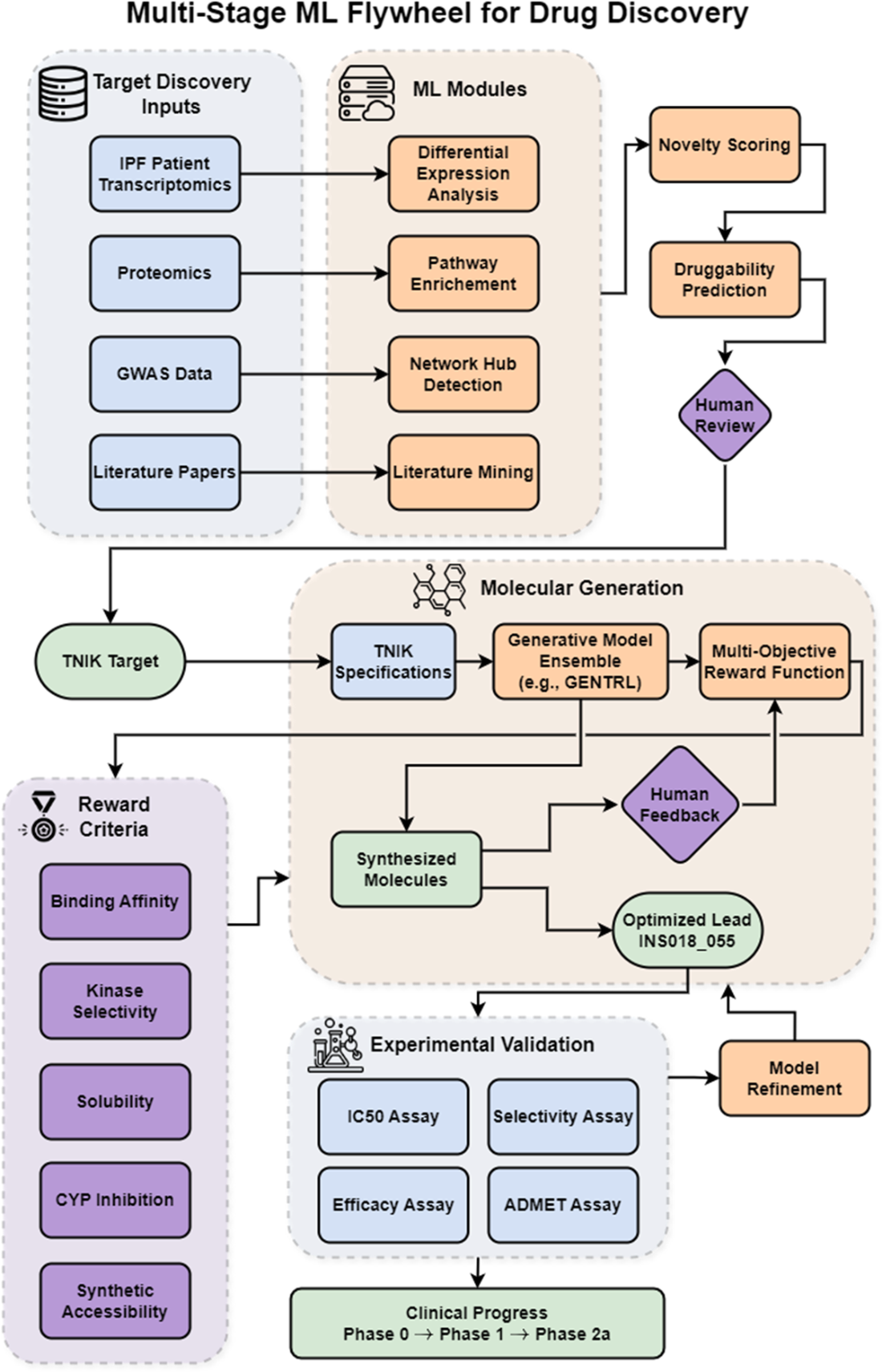
Trace how target analysis, molecular generation, experimental feedback, and clinical development connect in the rentosertib program. section 13.3.1
