The Chinese Room argument challenges the inference that fluent, correct output demonstrates understanding. A person who knows no Chinese follows an English rulebook to answer Chinese messages; outsiders see meaningful replies, while the person sees symbols. section 1.5.4
Searle compares the room to digital computers: rule-governed symbol manipulation supplies syntax, not semantics. He argues computation alone cannot yield understanding, which he connects to biological processes, consciousness, and intentionality. Critics respond that understanding may belong to the system as a whole. The distinction also informs discussion of language models, whose statistical relationships lack experiential grounding. section 1.5.4 section 1.7
Figure 1.8 The Chinese Room thought experiment. A person who does not understand Chinese sits inside a room with a rulebook written in English that explains how to manipulate Chinese symbols. By following these instructions, the person produces correct responses to messages written in Chinese. To an external observer the replies appear meaningful, even though no one inside the room understands the language.
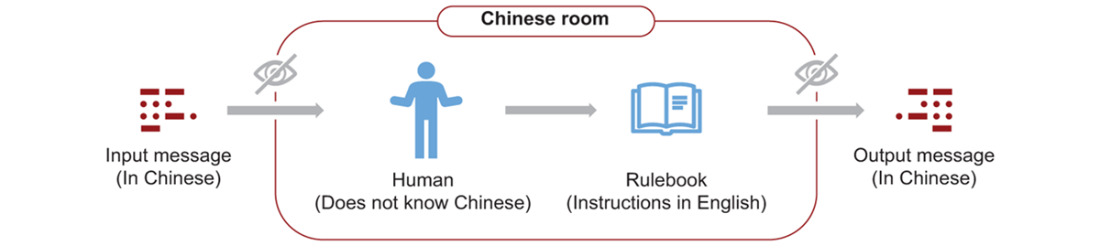
Trace how rule-following inside the room produces replies that appear meaningful from outside. section 1.5.4

