Chirality is the property of an entity that cannot be superimposed on its mirror image. In molecules, mirror-image forms can share a formula and connectivity yet behave very differently in biological systems. section 1.2.1
Key ideas:
- Stereoisomers have the same chemical formula and atomic connectivity but different spatial arrangements. section 1.2.1
- A tetrahedral carbon with four different substituents is a chiral center, allowing two arrangements. section 1.2.1
- Thalidomide illustrates the stakes: its enantiomers produced different effects, although the molecule rapidly interconverted between forms in the body. section 1.2.1
Computational molecular representations must preserve stereochemical information when distinguishing isomeric structures; isomeric SMILES provide examples of such representations. section 1.2.1
Figure 1.3 Example pairs of isomeric SMILES.
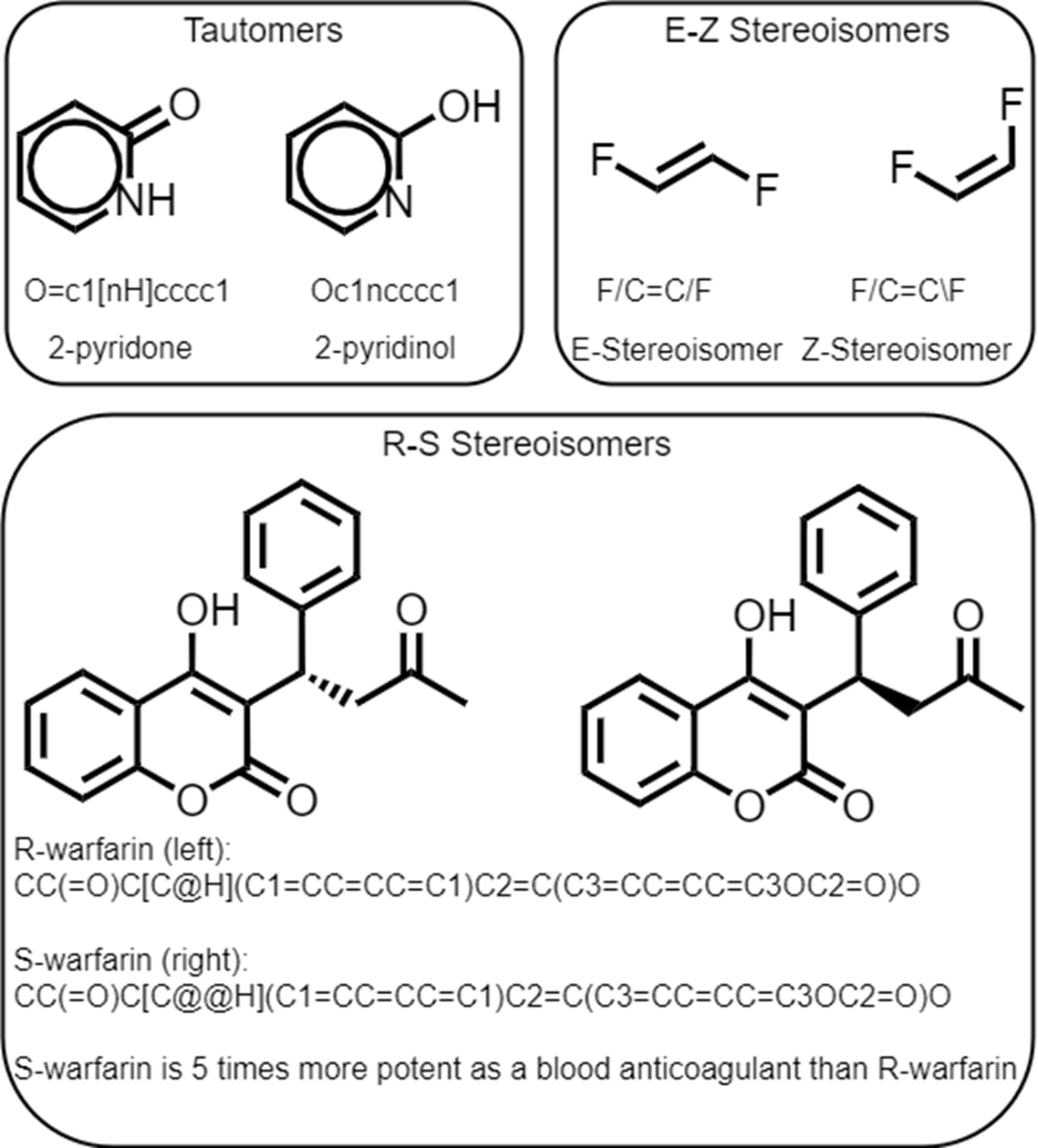
Compare paired isomeric structures and their SMILES to connect three-dimensional arrangement with molecular notation. section 1.2.1
