A chromosome is an encoded candidate solution in a genetic algorithm (GA). Its elements, called genes, hold decision values or solution components. A population contains multiple chromosomes; the GA evaluates them and produces new candidates over successive generations. section 7.3.2 section 7.2.2
The name comes from biology: genes occupy positions on a chromosome, and their combination forms a genotype. In a GA, the useful question is practical: how should a solution be represented so it can be evaluated and changed? Binary strings, real values, and permutations are possible encodings. The choice of encoding affects GA performance. section 7.2.1 section 7.3.2
Encoding a ticket price
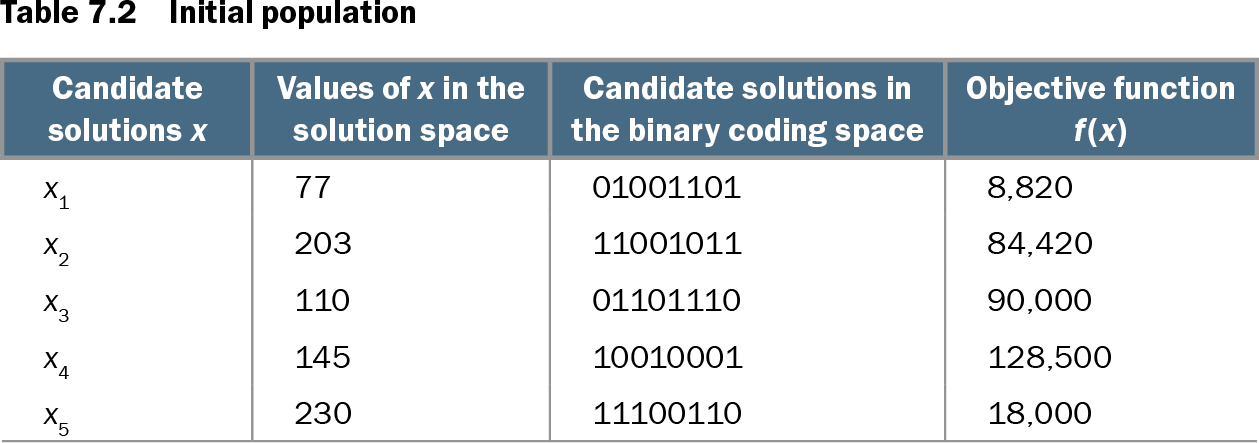
Suppose a conference organizer wants to maximize profit with a ticket price between $75 and $235. In a binary GA, an eight-bit chromosome represents a candidate price: 10010001 represents 145. Each candidate can be decoded and scored with the profit function. The worked implementation reports a best price of $155 and profit of $130,500. section 7.3.2 section 7.4
Table 7.2 Initial population (view table figure)
| Candidate solutions x |
Values of x in the solution space |
Candidate solutions in the binary coding space |
Objective function f(x) |
|---|---|---|---|
| x1 |
77 |
01001101 |
8,820 |
| x2 |
203 |
11001011 |
84,420 |
| x3 |
110 |
01101110 |
90,000 |
| x4 |
145 |
10010001 |
128,500 |
| x5 |
230 |
11100110 |
18,000 |
Compare candidate ticket prices, their eight-bit chromosomes, and their objective-function values in the initial population. section 7.3.2
To work with binary chromosomes in Python:
- Generate candidate prices, convert them with bin(), and pad them with zfill() so every chromosome has the same length. section 7.4
- Decode each chromosome to an integer and evaluate its fitness with the profit function. section 7.4
- Select parents, combine parts of their chromosomes through crossover, and introduce bit changes through mutation over repeated generations. section 7.4
A chromosome is therefore not the solution itself until its encoding is interpreted. Choose a representation that fits the decision variables, and check that generated candidates respect the problem’s bounds. A float-valued GA configured with pymoo offers another implementation path for the ticket-price problem. section 7.3.2 section 7.4