A churn funnel maps a user journey as ordered steps and shows how many users drop off at each step. It turns disengagement into a measurable experience problem: compare lesson progress, completion, timing, and abandonment to find where users stop. section 12.7.3
For a tutor bot, track a separate funnel for each lesson. A funnel can reveal whether students continue through the intended curriculum or stop after frustration or boredom. Investigating the conversations behind each drop-off helps designers improve the experience rather than treating churn as a single aggregate number. section 12.7.3
Lesson progression in a Sankey diagram
A Sankey diagram can show students moving from lesson 1 to lesson 2 and onward, while making skipped lessons and exits visible. Interactive diagrams can let analysts open the conversations associated with a drop-off. section 12.7.3
Figure 12.7 Sankey diagram of lesson funnels
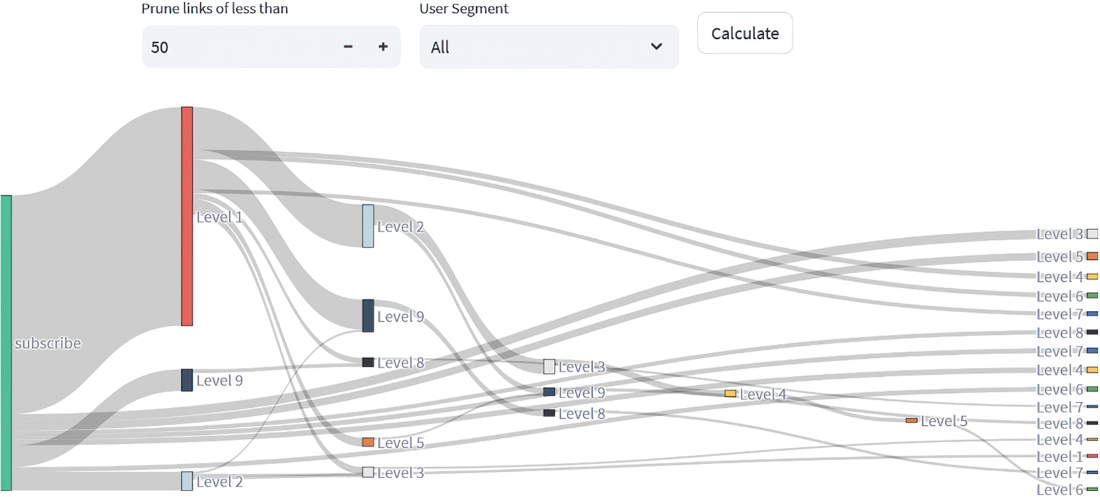
Use the Sankey figure to inspect lesson paths, continuation, skipping, and abandonment as flows. section 12.7.3
