liveBook · Manning

Ciphertext

As explained in Real-World Cryptography

Ciphertext is encrypted data produced from plaintext and intended to be decrypted by an authorized recipient.

When Alice sends a private message through an untrusted messenger, encryption transforms the plaintext into ciphertext: encrypted content that looks random to observers without the secret key. section 1.2 section 4.1

A symmetric-encryption exchange follows these steps:

  • Start with plaintext, such as text, an image, or a video represented as bits. section 4.1
  • Encrypt the plaintext with a secret key to produce ciphertext. section 1.2 section 4.1
  • Transmit the ciphertext; an observer should see random-looking data rather than the message. section 4.1
  • Decrypt the ciphertext with the same secret key to recover the original plaintext. section 1.2

Alice sends “hello”

Alice encrypts the plaintext “hello” with a shared key and sends Bob the resulting ciphertext. Bob uses that same key to decrypt it and recover “hello”; the messenger sees only noisy data. section 4.1

Figure 4.2 A cipher with a key can be seen as a permutation: it maps all the possible plaintexts to all the possible ciphertexts.
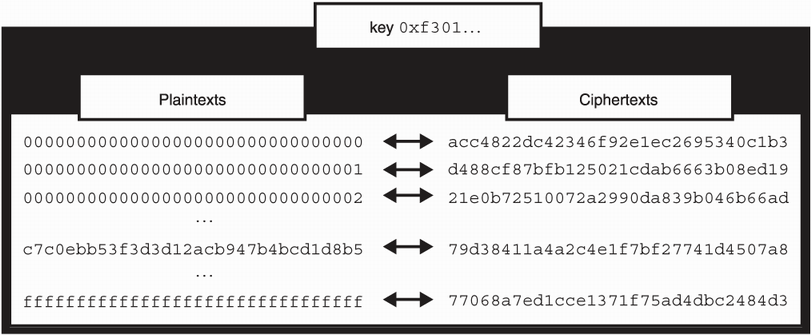
View ciphertext as one element of a reversible key-dependent mapping between plaintexts and ciphertexts. section 4.2.2


How Real-World Cryptography covers it

How deep it goes
Defines ciphertext, traces symmetric encryption and decryption, and connects AES ciphertext to reversible 128-bit mappings.
Examples
Uses Alice and Bob’s exchanged message, the plaintext “hello,” and AES’s fixed-size 128-bit input and output.
What it assumes
Assumes plaintext and a shared secret key, while treating key agreement as an initial in-person exchange.
What you can do after
Evaluate/understand how encryption produces ciphertext and how authorized decryption recovers plaintext with the shared key.
How it connects
Links ciphertext to plaintext, encryption, decryption, secret keys, symmetric encryption, block ciphers, AES, and confidentiality.

Also explained in

Compare how 5 books explain ciphertext →

Related concepts

This explainer was generated by Manning's knowledge graph from the text of Real-World Cryptography. The section links point to the parts of the book it draws on.


