A circuit breaker is a runtime control that stops or limits calls to a failing or dangerous operation before local failure becomes enterprise-wide harm. It is especially valuable when autonomous agents can trigger high-impact actions, such as freezing accounts or invoking an unavailable payment service. section 1.3 section 1.5.1
Use the pattern as part of a broader runtime control boundary:
- Stop an operation when confidence drops below a defined threshold, such as after detecting poisoned or corrupted input data. section 1.3
- Place the breaker at a consequential interface, such as the freeze-account API, so autonomous behavior cannot scale unchecked. section 1.5.1
- Combine circuit breakers with rate limits, kill switches, input validation, anomaly detection, and runtime policy enforcement. section 1.3 section 1.5.1
Poisoned threat-intelligence feed
A fraud agent begins freezing accounts after consuming manipulated threat-intelligence data. A circuit breaker on the freeze-account API halts the cascade before it reaches the entire customer base. Completed freezes are not automatically undone; recovery or compensating actions must be designed separately. section 1.3 section 1.5.1
Figure 1.5 Autonomy across architectural layers, showing how each layer acquires a runtime governance dimension without replacing existing structures.
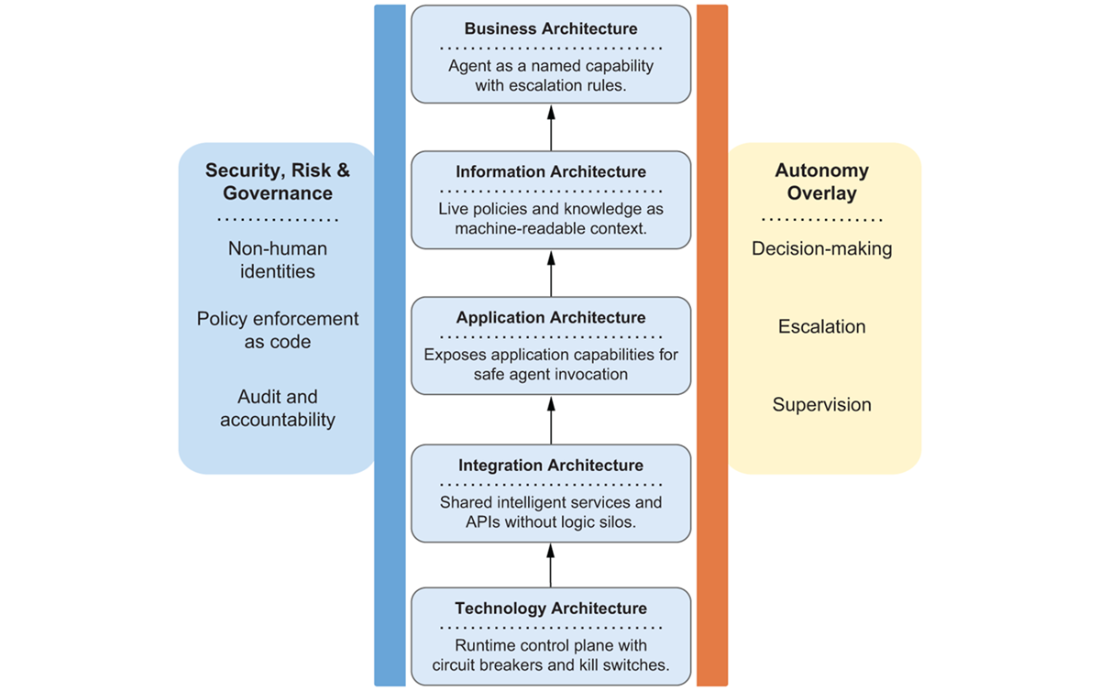
Shows how circuit breakers fit within technology architecture while runtime governance extends across business, data, application, integration, observability, and security layers. section 1.5.1