Cisco Meraki is a cloud-managed networking platform that uses a SaaS service and browser-based dashboard to centrally configure, monitor, and troubleshoot network devices. Meraki access points send management information through an encrypted internet tunnel, while client user data travels directly to the wired LAN. section 19.2.3 section 19.3
Key operating characteristics include:
- Uses the Meraki cloud rather than individual device administration or a required on-premises WLC. section 19.2.3
- Transports RF information, client statistics, and other management data through an encrypted tunnel to the cloud. section 19.2.3
- Provides centralized configuration, monitoring, deployment, health management, and troubleshooting. section 19.2.3 section 19.3
- Manages access points, switches, firewalls, and IoT devices such as cameras and sensors. section 19.2.3
- Differs from a cloud WLC deployment: Meraki uses SaaS-based device management, whereas a cloud WLC is a split-MAC WLC virtual machine. section 19.2.3
Traffic and management paths
An administrator uses the Meraki dashboard to manage an access point. The access point sends management and RF data to the cloud through an encrypted tunnel, but client user traffic proceeds directly to the wired LAN. section 19.2.3
Figure 19.11 Cisco Meraki offers cloud-based APs. Meraki APs are managed using Meraki’s cloud platform, which connects to each AP using an encrypted tunnel. User data traffic from clients is not tunneled to the cloud—only management traffic.
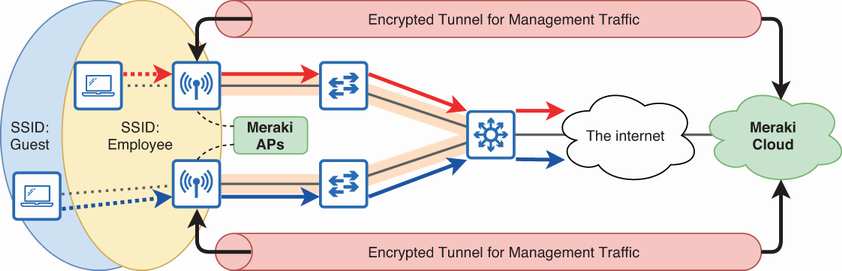
Diagram the encrypted management connection between Meraki access points and the cloud, while separating client data traffic onto the wired LAN. section 19.2.3
