Clipping (also called clamping) constrains a rounded quantized value to the integer type’s limits: q = clip(round(rS + Z), qmin, qmax). It prevents overflow, but values beyond the representable range saturate at a boundary. section 2.2
Clipping has two practical consequences:
- It limits integer outputs to qmin and qmax; signed int8, for example, uses −128 and 127. section 2.2
- It introduces overload error when values fall outside the quantization grid. Widening the grid reduces clipping but increases rounding error; tightening it reverses that tradeoff. section 2.6
Saturation at an integer boundary
With signed int8 limits, a rounded quantized value above 127 is clipped to 127 rather than stored beyond the type’s range. section 2.2
Figure 2.4 The ruler problem. Fixed-point quantization (left) forces a single rigid ruler on all measurements: a rice grain vanishes between coarse tick marks, while a watermelon extends beyond the ruler's edge and gets clipped. Affine quantization (right) manufactures a custom ruler for each object, with tick spacing (scale) and starting position (zero-point) tailored to the data's actual range.
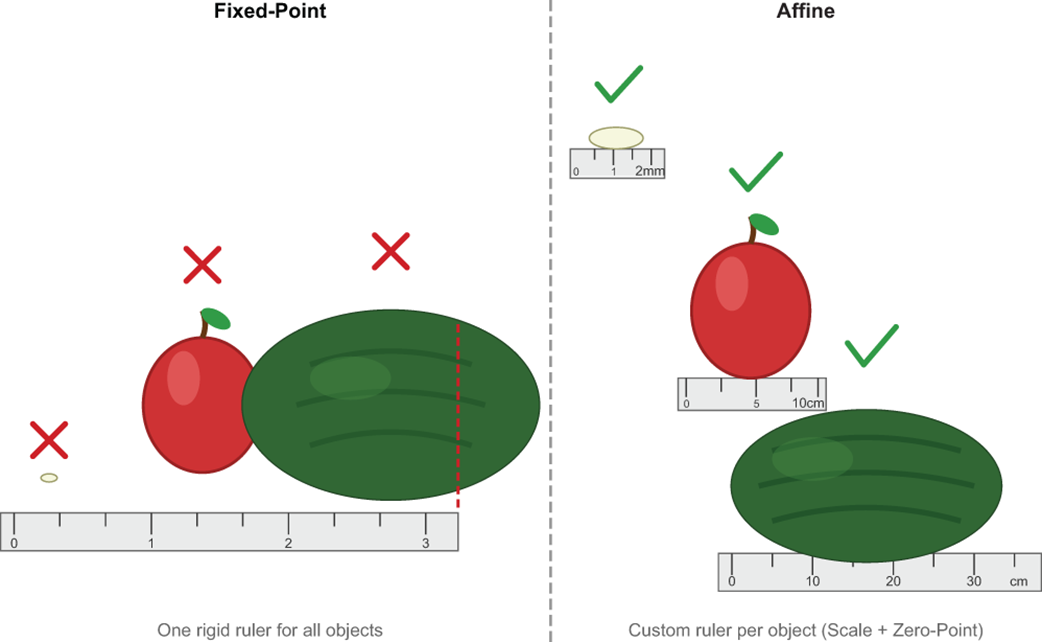
The ruler illustration contrasts values that fit the quantization range with an oversized value that extends past its edge and gets clipped. section 2.2