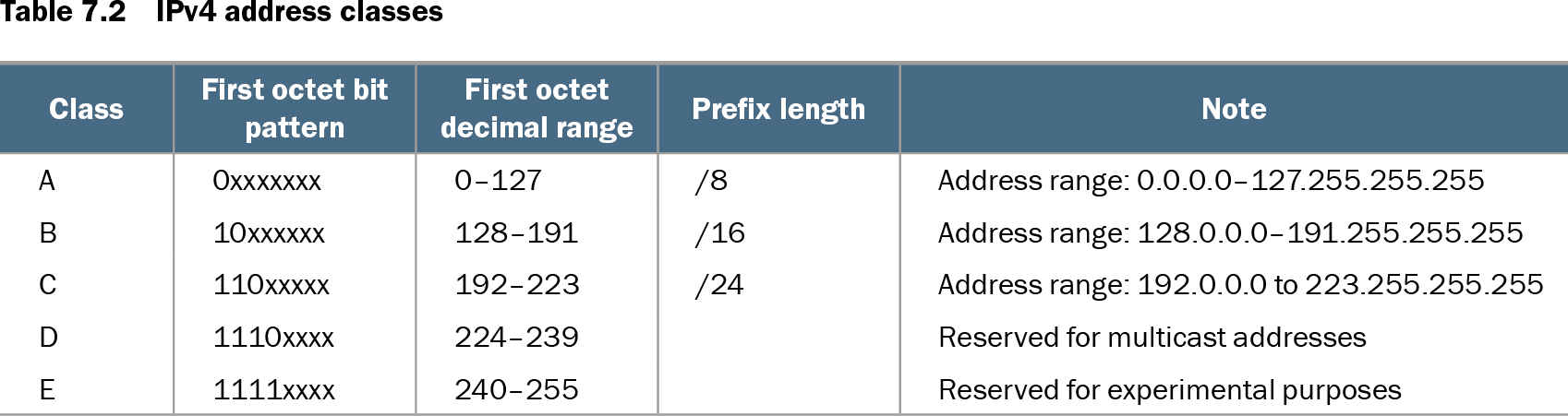
Class E is an IPv4 address class identified by the leading bit pattern 1111. Its first octet ranges from 240 through 255, and the range is reserved for experimental purposes rather than assignment to network hosts. section 7.3.4 section 7.4
Remember these classification points:
- Class E belongs to the five historical IPv4 address classes; hosts are assigned addresses from classes A, B, and C, while class D supports multicast. section 7.3.4
- Classful networking is obsolete and has been replaced by more flexible classless networking. section 7.4
Table 7.2 IPv4 address classes (view table figure)
| Class |
First octet bit pattern |
First octet decimal range |
Prefix length |
Note |
|---|---|---|---|---|
| A |
0xxxxxxx |
0–127 |
/8 |
Address range: 0.0.0.0–127.255.255.255 |
| B |
10xxxxxx |
128–191 |
/16 |
Address range: 128.0.0.0–191.255.255.255 |
| C |
110xxxxx |
192–223 |
/24 |
Address range: 192.0.0.0 to 223.255.255.255 |
| D |
1110xxxx |
224–239 |
Reserved for multicast addresses |
|
| E |
1111xxxx |
240–255 |
Reserved for experimental purposes |
Use the IPv4 address-class table to compare Class E’s 1111xxxx pattern and 240–255 first-octet range with the other classes. section 7.3.4