Classical preprocessing prepares a problem for a quantum subroutine by obtaining its classical description and converting it into the required input format. It commonly begins a hybrid quantum-classical workflow, although simple algorithms may omit it and iterative algorithms may repeat it. section 7.0 section 7.4
A preprocessing stage can:
- Read a problem description from a file or database. section 7.0
- Calculate the description on the fly with a classical program. section 7.0
- Convert the description into values accepted by the quantum subroutine. section 7.0
Molecular ground-state energy
A program can read a molecule’s structure from an FCIDump file, use classical processing to calculate the required values, and pass those values to a quantum algorithm. section 7.0
Figure 7.2 A quantum algorithm can combine classical and quantum computations. Typically, it starts with a classical data preprocessing step that prepares input data for the quantum computation and passes it to the quantum subroutine. The results of the quantum computation are then fed into another classical step, postprocessing, that converts them into the final problem solution. Some of these steps can be omitted for simple algorithms or repeated with some variation for iterative algorithms.
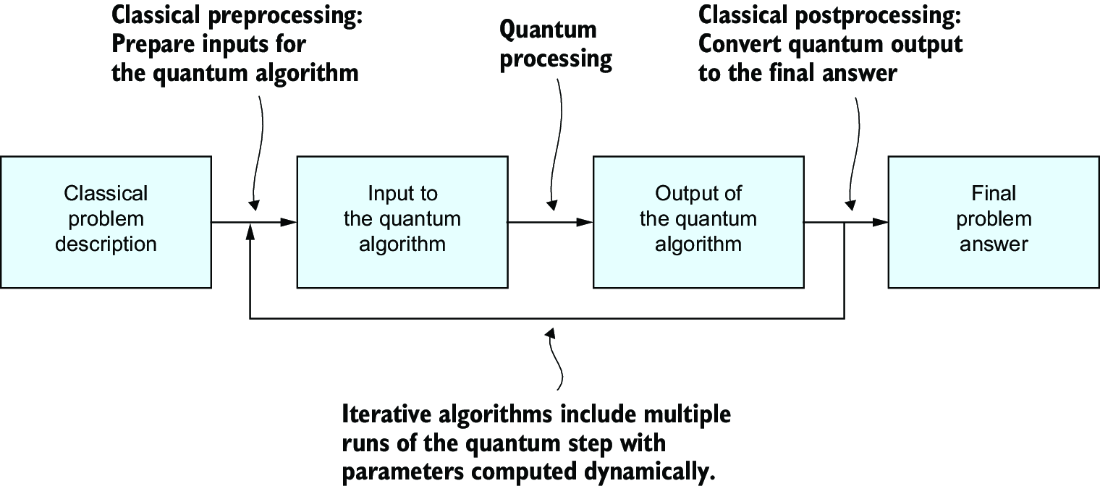
The workflow diagram connects preprocessing to the quantum computation and subsequent classical postprocessing, while showing where stages may be omitted or repeated. section 7.0
