A security level, or clearance level, classifies how sensitive information or operations are and helps determine whether a principal may access them. In attribute-based access control (ABAC), it is one attribute among the principal, resource, and environment signals used to make an authorization decision. section 6.2 section 12.3.1
Clearance does not decide access by itself. A policy may require a matching department, resource classification, managed device, permitted time, network conditions, or approved request purpose. The policy stays stable while current attribute values change from request to request. section 6.2 section 6.2.1
Typical authorization decisions combine clearance with other conditions:
- Permit a finance employee to view a regional quarterly report only when the employee has the required clearance and matches the resource conditions. section 6.2
- Permit production deployment for an engineer with high clearance on a managed device during business hours, or outside those hours when the engineer is on call. section 6.2 section 6.2.1
- Deny a request when the principal has low clearance, even if department and location otherwise match. section 6.2.1
Alice and Bob request the same financial document
Alice and Bob belong to the finance department and work from the same location. The policy also requires high clearance and a request before 6 p.m. Alice satisfies every condition and is permitted; Bob has low clearance and is denied. section 6.2.1
Figure 6.4 Attribute-based authorization with principal, resource, and environment attributes. Access decisions are based on evaluating policies in the context of attributes from multiple sources. Alice’s attributes meet the policy conditions, so access is granted. Bob’s do not, so access is denied.
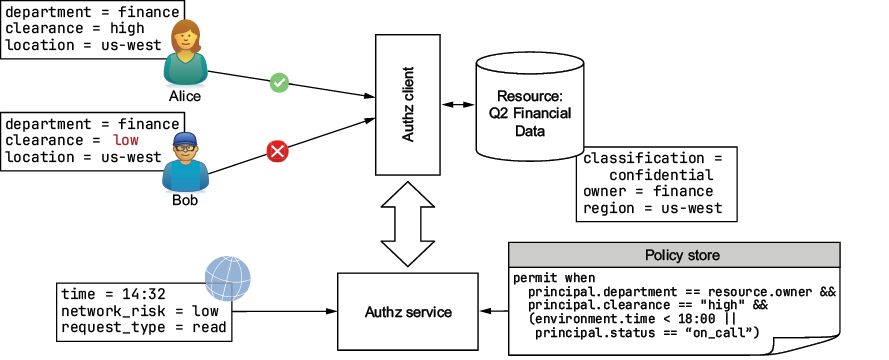
Shows how principal, resource, and environment attributes combine in an ABAC policy, with clearance separating Alice’s permitted request from Bob’s denied request. section 6.2
