ClickHouse is an open-source columnar database designed for analytical queries over hundreds of millions of rows in subsecond time frames. It supports logs, metrics, and traces on single machines or distributed deployments with sharding and replication. section 5.5
Use ClickHouse when analytical observability storage requires:
- Column-oriented storage for high-volume query workloads. section 5.5
- A backend for any signal type, from a single machine to sharded and replicated clusters. section 5.5
- Kubernetes operation supported by the Altinity Operator, with Apache ZooKeeper coordinating distributed deployments. section 5.5
OpenTelemetry logs with ClickHouse
A Docker Compose stack runs ClickHouse beside an OpenTelemetry Collector. The Collector receives Fluent Forward logs, batches them, exports them through a ClickHouse DSN, and applies a three-day TTL. SQL can then extract trace IDs from JSON bodies and search recent payloads.
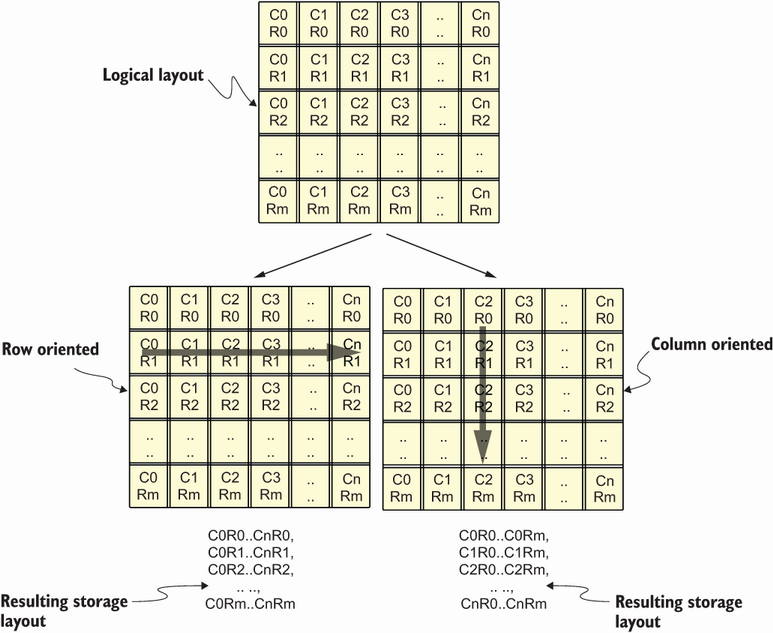
Compare row-oriented and column-oriented storage before choosing ClickHouse for analytical workloads. section 5.5
