liveBook · Manning

Clipped surrogate objective

As explained in Optimization Algorithms: AI techniques for design, planning, and control problems

A clipped objective function restricts the contribution of an optimization objective to a bounded range of values.

A clipped surrogate objective limits how much an updated policy can benefit from changing action probabilities. In PPO, it compares the new policy with the old one through a probability ratio and maximizes the smaller of the ordinary policy-gradient term and its clipped version. section 12.1.5

Why clipping matters

Suppose an action has a positive advantage, meaning it performed better than expected. PPO increases its probability, but the objective flattens when the ratio becomes too large. With epsilon set to 0.2, clipping constrains the effective ratio to the interval from 0.8 to 1.2, preventing a single update from moving the policy too far. section 12.1.5

The mechanism combines several practical controls:

  • Uses the probability ratio between the updated and previous policies. section 12.1.5
  • Compares the ordinary policy-gradient objective with a clipped alternative and selects the smaller value. section 12.1.5
  • Restricts policy changes to promote smoother, more stable learning while balancing exploration and stability. section 12.7
Figure 12.6 Clipped surrogate objective in PPO
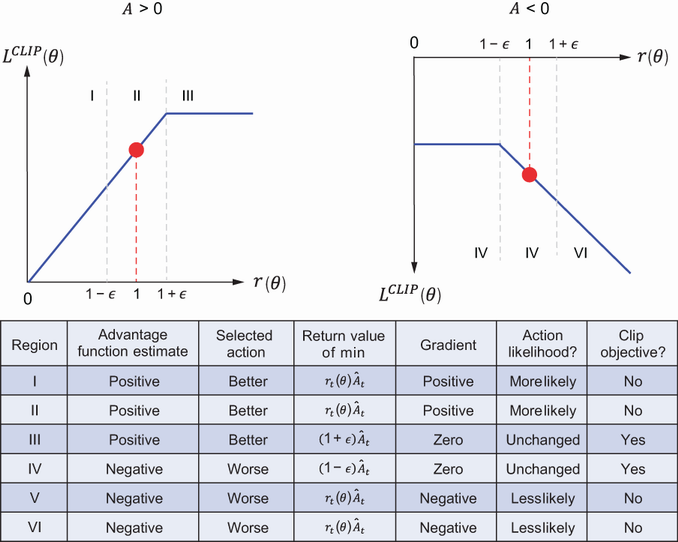
Use the figure to inspect how positive and negative advantages change the objective as the probability ratio moves beyond the clipping range. section 12.1.5


How Optimization Algorithms: AI techniques for design, planning, and control problems covers it

How deep it goes
Explains the ratio, minimum operator, epsilon range, and advantage-dependent behavior, but does not derive the full objective.
Examples
Uses probability-ratio cases, positive advantages, epsilon equal to 0.2, and a clipped-objective figure.
What it assumes
Assumes policy updates, action probabilities, and advantage estimates while situating them within reinforcement-learning environments.
What you can do after
Apply it via PPO to maintain controlled policy changes during reinforcement-learning updates.
How it connects
Connects policy gradients, advantage estimation, proximal policy optimization, reinforcement learning, and KL divergence.

Also explained in

Compare how 2 books explain clipped surrogate objective →

Related concepts

This explainer was generated by Manning's knowledge graph from the text of Optimization Algorithms: AI techniques for design, planning, and control problems. The section links point to the parts of the book it draws on.