A closed-domain task uses a specific context, document, or database as the boundary for what an answer may claim. The supplied material acts as a source of truth, making outputs testable against verifiable evidence rather than subjective truth. section 5.1 section 5.1.1
Classify the task before selecting a hallucination detector:
- Identify a supplied source, such as retrieved documents, a source text, or database records. section 5.1.1 section 5.3
- Compare the generated output with that source to test contextual grounding: whether the system stayed within the provided material. section 5.1.1
- Verify individual claims with natural language inference, which classifies the source relationship as entailment, contradiction, or neutral. section 5.1.1
Reference-based verification
A retrieval-augmented generation system can compare its answer with retrieved documents; a summarizer can compare its summary with the source text; structured question answering can check claims against database records. These reference-based signals are stronger when grounding material is available. section 5.3 section 5.1.1
Figure 5.1 A flow chart for choosing a hallucination detection strategy. Closed-domain tasks can use grounding based on sources to verify claims. Open-domain tasks require self-consistency checks, or rely on external fact retrieval, or other factual alignment signals.
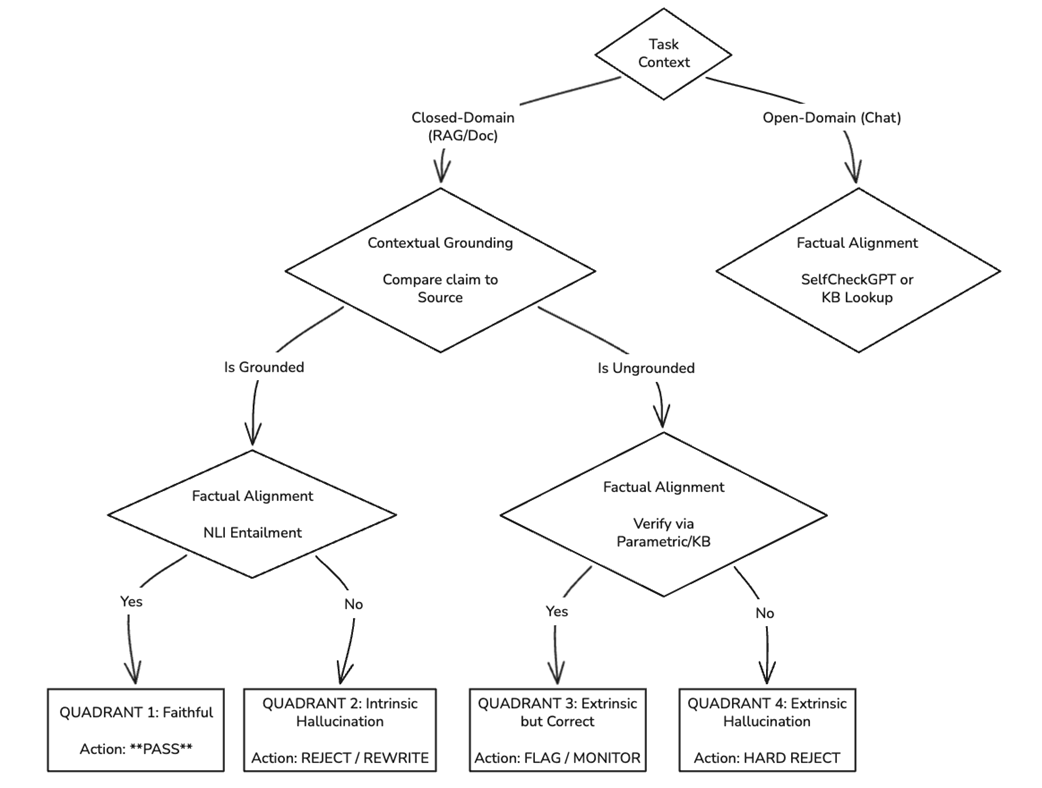
Use the decision flow to connect closed-domain tasks with source grounding and distinguish them from open-domain tasks that require other factual-alignment signals. section 5.1
