Closed-loop learning uses experimental results to improve predictions or design decisions in the next round of discovery. In drug discovery, the loop helps decide which target-and-molecule hypotheses deserve scarce experimental effort. section 13.0
A Design-Make-Test-Learn cycle puts the idea into practice:
- Design candidate molecules and use predictions to select experiments. section 13.0 section 13.2.3
- Make and test the selected compounds, then feed the measurements back to update the models. section 13.2.3
- Repeat with improved predictions and revised design priorities. section 13.2.3 section 13.3.1
Active learning makes the loop more data-efficient by selecting informative compounds rather than sampling randomly or exhaustively. Selection can balance predicted value against uncertainty. At the start, however, too few labeled examples may make both predictions and uncertainty estimates unreliable; early cycles can favor diverse selections instead. section 13.2.3
Optimizing a TNIK inhibitor
In the rentosertib program, an initial batch of 20 structurally varied molecules produced ISM001, a strong TNIK inhibitor. A second round made 30 analogs to improve selectivity against other kinases; a third made 30 molecules to improve solubility and metabolic stability. Data from each stage refined the predictive models. The optimized lead, INS018_055, then proceeded to preclinical validation. section 13.3.1
Figure 13.7 The four stages of the rentosertib program. Multi-omics data and literature flow through PandaOmics to a scored target list; Chemistry42 generates and optimizes candidates against a multi-objective reward; experimental readouts feed back to refine the models; clinical development follows. Sections 13.3.1 through 13.3.4 walk through each stage.
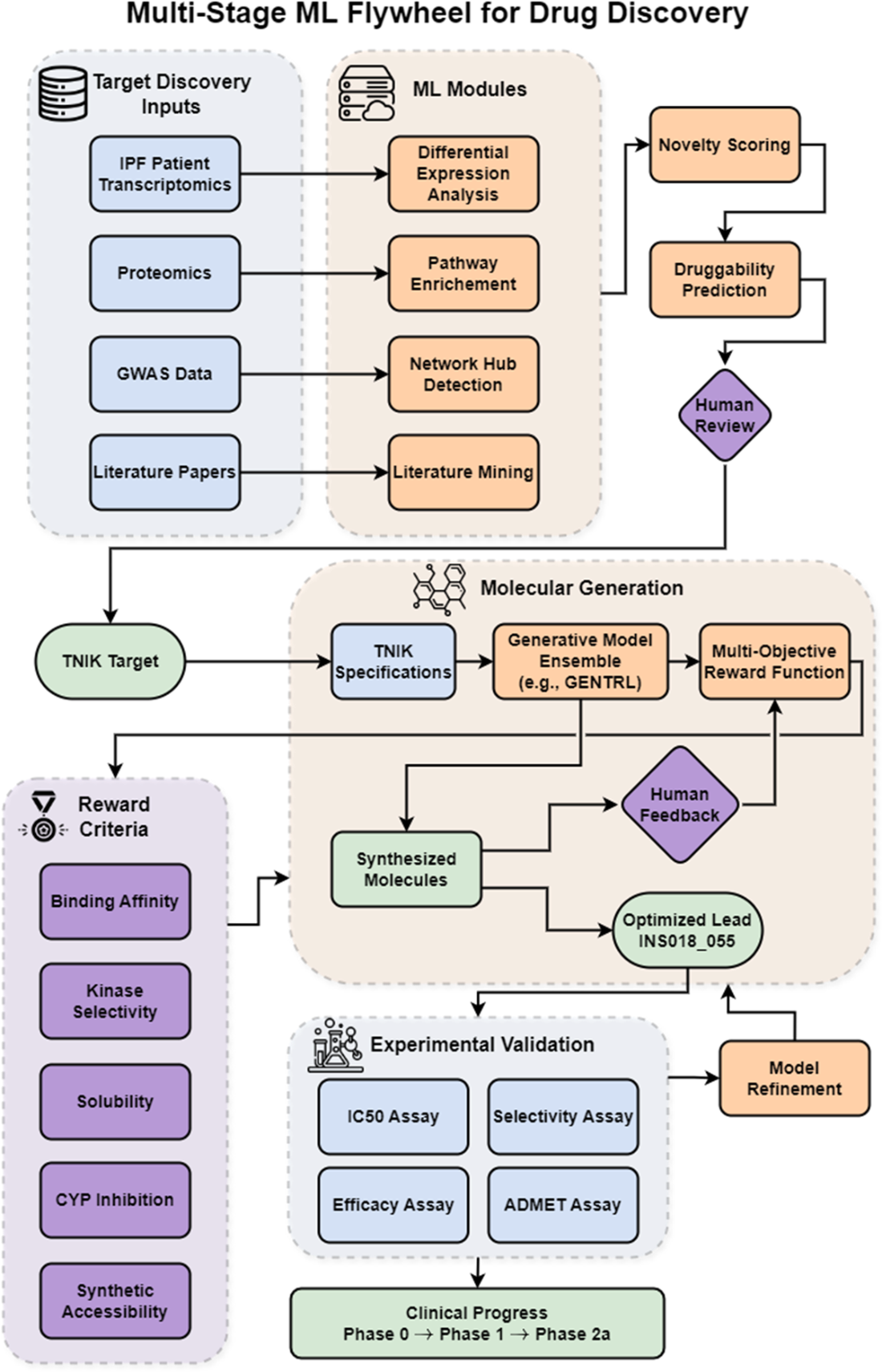
Trace how experimental readouts feed back into candidate generation and optimization before clinical development. section 13.3.1
