Cloud Deploy is a fully managed continuous-delivery service that promotes application releases through a defined sequence of target environments. Delivery pipelines control the sequence, while releases and rollouts manage application lifecycle and deployment progress. section 12.5 section 12.5.2
A typical Anthos CI/CD flow combines CI tooling, Cloud Build, Skaffold, Cloud Storage, Operations Suite, Pub/Sub, and GKE or Anthos clusters. Cloud Build uses Skaffold to render manifests and deploy them to the selected runtime. section 12.5.1
Configure a pipeline by:
- Defining a delivery pipeline with ordered targets such as test, staging, and production. section 12.5.2
- Defining target files that identify each GKE or Anthos cluster. section 12.5.2
- Providing a Skaffold configuration, container image, and Kubernetes manifest generated or prepared by CI. section 12.5.2
- Registering the resources, creating a release, and promoting or approving rollouts as required. section 12.5.2
Three-stage promotion pipeline
A delivery-pipeline.yaml file can define web-app with serial stages targeting test, staging, and prod. Register the pipeline and target files with gcloud deploy apply, then create a release with gcloud deploy releases create RELEASE_NAME --delivery-pipeline=PIPELINE_NAME. Promote it with gcloud deploy releases promote or require approval on a production target.
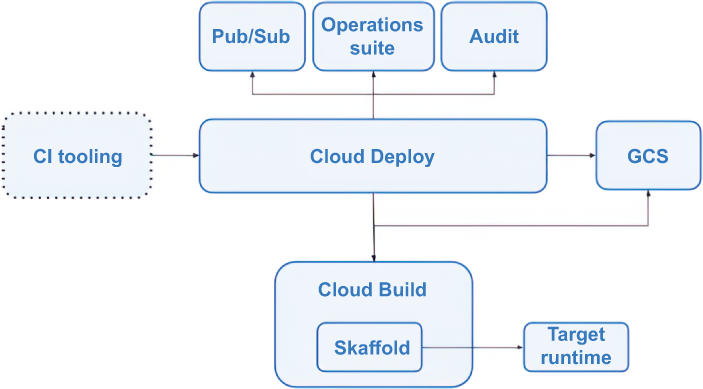
The ecosystem diagram maps Cloud Deploy to CI tooling, Cloud Build, Skaffold, observability, messaging, storage, and target clusters. section 12.5.1
