A cloud service model defines how management and responsibility are divided between a cloud service provider and its customer. As the provider takes on more technology layers, the customer’s operational burden decreases; responsibility for security is not automatically transferred entirely to the provider. section 13.5
Compare the models by which layers the provider manages:
- Infrastructure as a Service (IaaS): the provider manages the data center, hardware, and virtualization; the customer manages the operating system, applications, and data. section 13.5
- Platform as a Service (PaaS): the provider also manages the operating system, while the customer focuses primarily on applications and data. section 13.5
- Software as a Service (SaaS): the provider manages nearly all layers, including applications; the customer remains responsible for data. section 13.5
Figure 13.4 Comparison of responsibilities of users and vendors for the distinct service models
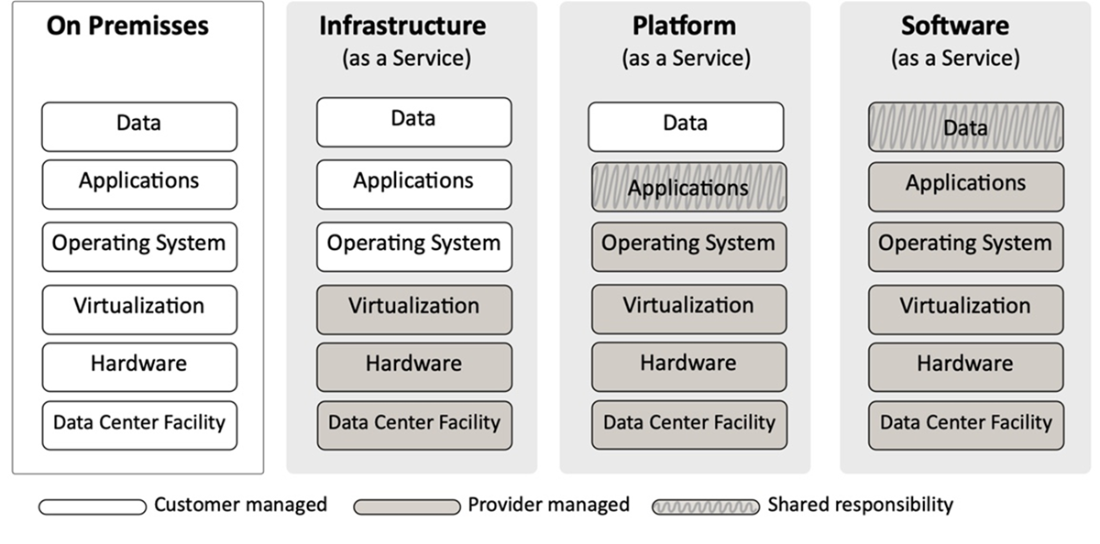
Use the comparison to see how provider and customer responsibilities shift across the service models. section 13.5
|
Service
Model
|
Examples
|
|
Infrastructure as a Service (IaaS)
Provides
virtualized computing resources (servers, storage, networking) on demand.
|
Amazon EC2,
Microsoft Azure Virtual Machines, Google Compute Engine.
|
|
Platform as a Service (PaaS)
Offers a
ready-to-use platform for building, testing, and deploying applications
|
Google App
Engine, Microsoft Azure App Service, Heroku.
|
|
Software as a Service (SaaS)
Delivers
fully managed software applications over the internet
|
Gmail,
Microsoft 365, Slack, Atlassian JIRA
|
The examples connect each model to familiar services, including Amazon EC2, Heroku, and Gmail. section 13.5
