A cluster node is an independent JVM running an Akka ActorSystem and participating in a peer-to-peer cluster. Nodes communicate over the network, while actor location remains transparent to business logic: an actor can reside locally or on another node without changing how it is addressed. Adding nodes distributes load; removing or losing nodes is an expected part of operating a fault-tolerant application. section 8.0 section 8.2
Each node has a unique network address and moves through membership states. Seed nodes provide initial contact points: the first seed forms the cluster, then other seed and non-seed nodes send join requests and become Up after the leader manages the membership transition. A node may contain only an ActorSystem, making pure seed nodes possible. section 8.2.1 section 8.2.3
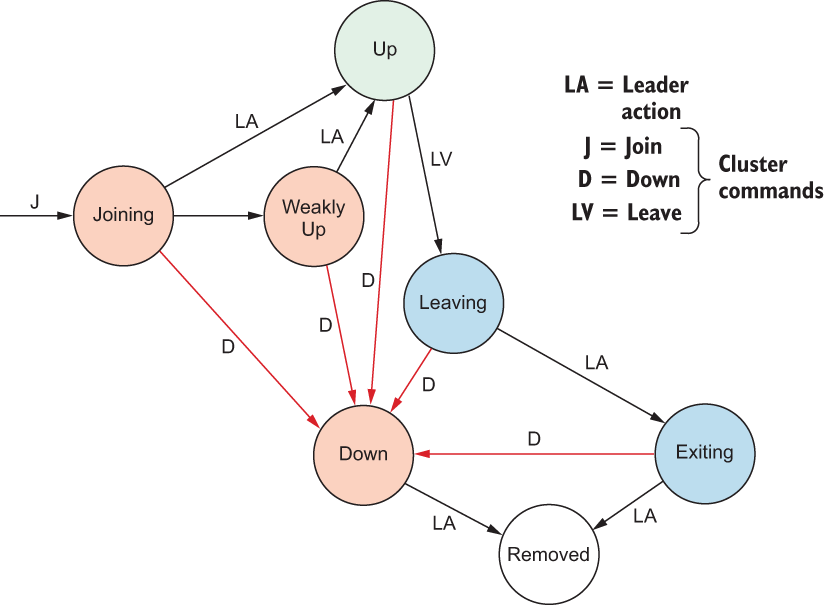
Use the lifecycle diagram to distinguish normal membership transitions from states that require operational intervention. section 8.2.3
Run nodes with distinct responsibilities by assigning cluster roles:
- A director node can create a master and router after receiving SelfUp, delaying work until required members are available. section 8.4.2
- Aggregator nodes can create configured workers that register with the router and asynchronously process delegated texts. section 8.4 section 8.4.2
- Seed nodes can bootstrap membership without hosting business actors. section 8.2.1
Word-counting cluster
Start one seed node, one director node, and two aggregator nodes on separate ports. Once the configured minimum of one seed and two aggregators is joining, the members can become Up. The director's master sends texts to workers at random; workers return word-frequency maps, and the master merges results. This separates distributed deployment concerns from the counting logic. section 8.4 section 8.4.2
A node can become unreachable because of a network partition, a long garbage-collection pause, or an ungraceful shutdown. An unreachable node cannot rejoin directly and must be shut down; start a new node instead. Akka Management exposes member status through HTTP and, when write operations are enabled, can issue join, leave, or down operations for a node address. section 8.2.5 section 8.3


