The clustering assumption treats each class as occupying one cluster or a small number of localized regions in feature space. Classification can use this structure, but outlier detection often cannot. section 15.3.2
Outliers usually appear wherever normal data is absent, so they are dispersed rather than clustered. A dense outlier cluster would generally cease to be an outlier group, except when it represents a pattern absent during training. section 15.3.2
Figure 15.8 Left pane: dataset with known outliers. Inliers are drawn as dots and outliers as stars. Conceivably, we can create a classifier to separate these, but as the outliers are distributed throughout the space, it is not clear where to draw the decision boundary. This is much more of a problem in higher dimensions. Right pane: where there are many examples each of a small number of specific outliers, it is more feasible to classify these.
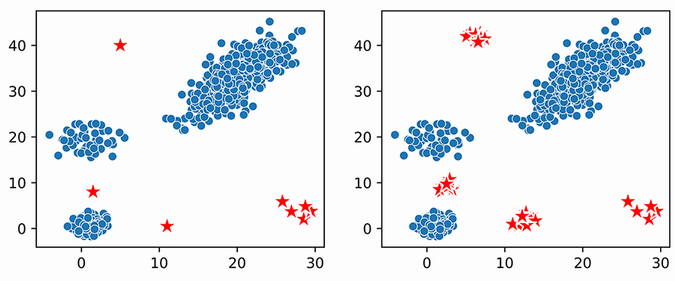
A synthetic dataset shows three large inlier clusters and scattered known outliers, illustrating why a classifier cannot determine reliable boundaries around future outliers; classification becomes more feasible when specific outlier types form repeated small clusters. section 15.3.2
