A coalition is any subset of cooperating players whose collective effectiveness or value is evaluated. In SHAP, coalitions reveal how a feature or player changes a prediction or total reward when included. section 9.4.2
Prize-sharing example
Four data scientists form coalitions while pursuing a $20,000 Kaggle prize. Ava alone is worth $7,000; Ava, Ben, and Dev together are worth $13,000; all four form the grand coalition worth $20,000. section 9.4.2
A coalition table organizes the evaluation:
- List every subset, including the empty coalition and the grand coalition. section 9.4.2
- Assign each coalition a characteristic-function value representing its effectiveness or worth. section 9.4.2
- Compare corresponding coalitions with and without one player to measure that player’s contribution. section 9.4.2
Figure 9.16 All possible coalitions of Ava, Ben, Cam, and Dev, and their corresponding values (in units of $1,000). The last coalition contains all four friends and has a value of $20,000, the total prize money. There is one coalition of size 0, four coalitions of size 1, six coalitions of size 2, four coalitions of size 3, and one coalition of size 4. This table is called the characteristic function.
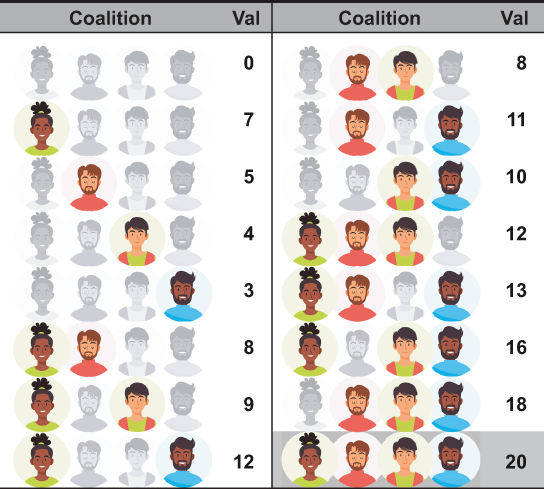
The figure shows the complete characteristic function: one empty coalition, four single-player coalitions, six pairs, four triples, and the four-player grand coalition. section 9.4.2
