As coffee and cream mix, the fine-grained grid becomes speckled and increasingly random. Coarse-graining replaces small neighborhoods with averages, then quantizes those averages into labels such as coffee, cream, and mixed. The resulting macrostate discards microscopic randomness while retaining large-scale structure, such as boundaries and cream filaments. Compressing this array provides an estimate of its description length and apparent complexity. section 8.1.1 section 8.1.1
Coffee and cream mixing
At first, a coarse-grained image shows simple blocks of coffee and cream. Midway through mixing, irregular gray regions reveal local differences in the mixture; later, the image becomes nearly uniform gray. The estimated complexity rises and then falls across these stages, even as entropy steadily increases. Interacting dynamics produce a more structured midpoint and a larger complexity peak than independent diffusion. section 8.1.2 section 8.1.2
Figure 8.2 Illustration of the construction of the coarse-grained array using an example grain size of 3. The values of the shaded cells on the left are averaged to produce the value of the shaded cell on the right. Used with permission granted by the lead author (Scott Aaronson).
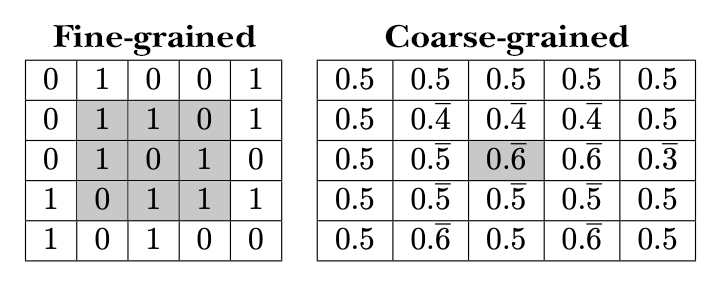
Shows how neighborhood values are averaged to form a coarse-grained cell. section 8.1.1
