The code and tools layer (L4) is the deepest agent infrastructure layer. It comprises the harness’s source code, tool implementations, and orchestration logic. Improving it can change more than code: it may also affect artifacts in other layers. section 1.3.2
One change, multiple layers
A change to L4 may regenerate a tool description in L1, restructure memory storage in L2, or rewire a metacognitive scaffold in L3. section 1.3.2
Figure 1.8 The harness artifact layers of self-improvement. The frozen model (LLM) serves as the unchanging substrate below. The four artifact layers stacked on it are shared infrastructure, inherited by every instance of the agent. Layer zero is the toolkit, the engineering work that measures, searches, and applies, reused at every layer.
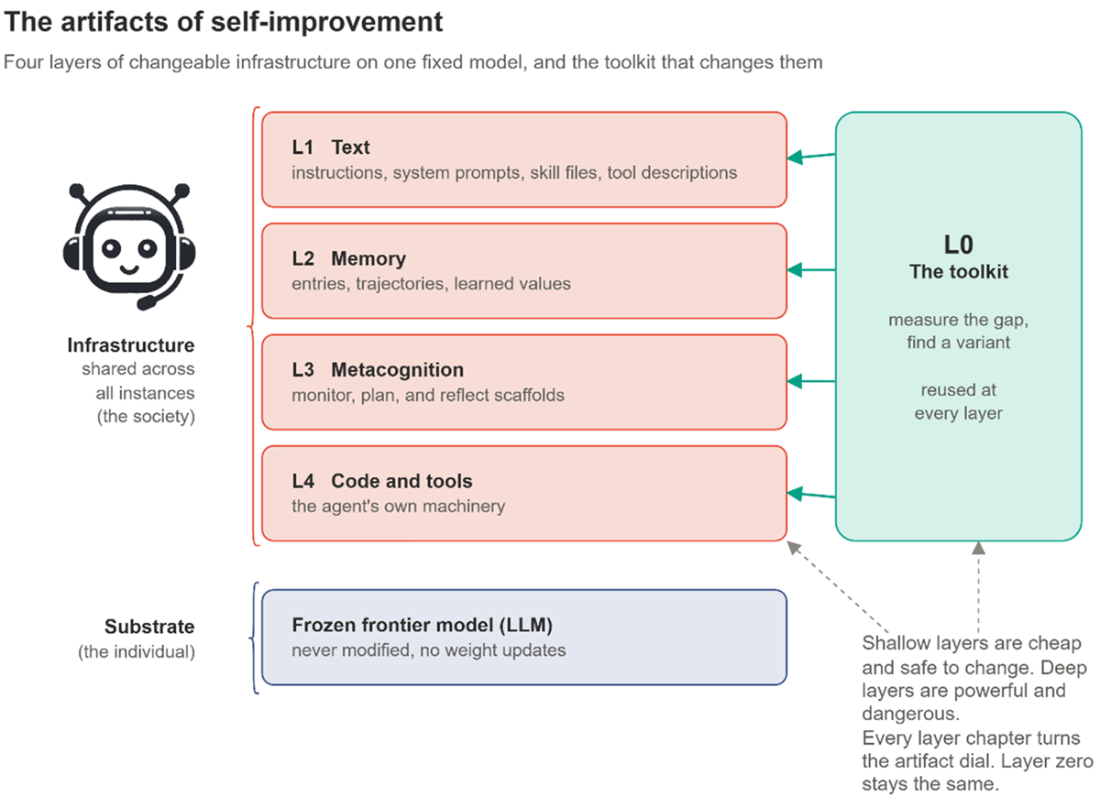
Use the layer diagram to see L4 in relation to the other artifact layers, the frozen model, and the shared toolkit. section 1.3.2