liveBook · Manning

CodeCarbon

As explained in Introduction to Generative AI, Second Edition

CodeCarbon is an open-source software tool that estimates the energy consumption and carbon-dioxide-equivalent emissions of computational workloads.

CodeCarbon is an open-source tool that runs alongside computational work to estimate electricity use and carbon-dioxide-equivalent (CO2eq) emissions. It can run on a personal computer and measure the power consumed by its CPU, RAM, and GPUs. section 11.3

Its estimates make computing costs more visible, especially for energy-intensive training and large-scale inference. CO2eq combines greenhouse gases into a common reporting measure, while the resulting figures remain estimates rather than complete environmental accounts. section 11.3

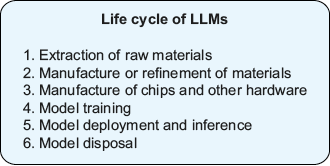
Figure 11.2 The life cycle assessment of LLMs [52]
A white sign with black text

AI-generated content may be incorrect.

Use the lifecycle assessment to place CodeCarbon’s energy measurements within the broader environmental costs of large language models. section 11.3

How Introduction to Generative AI, Second Edition covers it

How deep it goes
Explains parallel measurement and tracked hardware, but stops short of implementation details or complete lifecycle accounting.
Examples
Measures CPU, RAM, and GPU electricity consumption from a personal computer while code runs.
What you can do after
Operate it to estimate and report the electricity consumption and CO2eq emissions of computational workloads.
How it connects
Connects computational emissions with LLM training, inference, data centers, cooling, and environmental reporting.

Related concepts

This explainer was generated by Manning's knowledge graph from the text of Introduction to Generative AI, Second Edition. The section links point to the parts of the book it draws on.