Cognitive complexity estimates the mental effort needed to follow a method’s control flow. It focuses on interruptions to a straightforward top-to-bottom reading path: branches, loops, nesting, and mixed logical conditions make a reader hold more possible paths in mind. The goal is not merely shorter code, but code whose main story can be understood without repeatedly reconstructing its flow. section 3.1.2 section 3.0
It differs from cyclomatic complexity. Cyclomatic complexity counts independent execution paths and is useful for reasoning about testing; cognitive complexity instead emphasizes the immediate burden of understanding a method. Two methods can therefore have similar path counts while feeling very different to read when one is deeply nested or combines complicated conditions. section 3.1.2 section 3.3
Figure 3.2 Each flow-breaking structure (i.e., for, if, else) and each level of nesting increase cognitive complexity. In this example, the developer must keep track of several different execution paths to understand the overall logic.
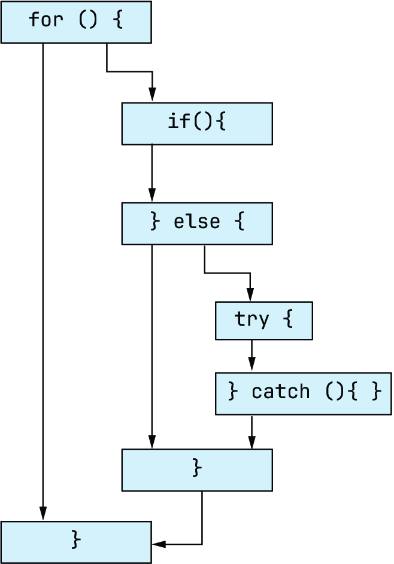
Use this diagram to spot the two main contributors: every flow-breaking structure adds effort, and each nesting level makes the surrounding paths harder to retain. section 3.1.2
Refactor the email-reminder flow
A reminder method begins with a loop, a compound eligibility condition, and a nested try/catch, scoring 8 points. Extracting eligibility and sending into named methods lowers the coordinating method to 3 points, even though the extracted logic still has scores of its own. The improvement is local: a reader can now understand the high-level action—find eligible customers, then send reminders—without unpacking every detail. A flat stream pipeline can reduce that coordinating method further when declarative iteration makes the flow clearer. section 3.2.3 section 3.1.2
Reduce cognitive complexity when the resulting code tells a clearer story:
- Limit nesting by extracting nested conditional or loop bodies into well-named methods or functions. section 3.2.3
- Return early when it avoids wrapping the remaining work in another branch. section 3.2.3
- Use flat declarative iteration when it removes explicit control-flow blocks without hiding the operation’s intent. section 3.2.3
- Merge consecutive conditionals with the same outcome, or replace long conditional chains when a clearer structure is available. section 3.2.3
Treat the score as a signal, not a universal verdict. A familiar, direct Kotlin if/else chain can score 4 yet remain readable when its conditions are simple. Conversely, reducing a score through abstraction is not automatically an improvement: hiding too much can obscure logic and make debugging harder. Use the metric alongside readability, naming, conciseness, safety, and closeness to the problem. section 5.1.3 section 3.3 section 5.3
Table 3.1 Strategies to reduce cognitive complexity
|
Strategy
|
Description
|
Points avoided
|
|---|---|---|
|
Limit nesting depth
|
Refactor nested conditional or loop blocks by extracting them into well-named methods or functions.
|
+1 per level of nesting removed
|
|
Early return
|
Exit a function as soon as a condition is met to avoid unnecessary branching and reduce nesting depth. (While older guidelines promoted a single entry and exit point, in modern code, this often increases nesting and cognitive load.)
|
+1 per avoided nesting level
|
|
Prefer declarative iteration
|
Use flat, declarative constructs (such as pipeline-style operations) instead of explicit loop blocks when they simplify control flow.
|
+1 per loop avoided, more if a complex condition is eliminated
|
|
Combine conditionals
|
Merge consecutive conditional statements that share the same outcome.
|
+1 per statement removed
|
|
Replace long conditional chains
|
Prefer structured branching constructs (e.g., switch expressions) instead of long if/else when possible.
|
Up to +
n–1 (where
n = number of if-else branches)
|
|
Simplify conditions
|
Avoid mixing multiple logical operators in a single expression when possible.
|
+1 per mixed logical operator avoided
|
|
Extract Boolean expressions
|
Move complex Boolean logic into clearly named functions or methods.
|
Removes all points from the original expression (typically 1 to 3 points)
|
|
Avoid labeled loops
|
Avoid labeled breaks or jumps that force readers to mentally traverse distant blocks of code.
|
+1 per label removed
|
Consult these reduction strategies as decision criteria, especially when nesting, avoidable branches, or explicit loops dominate a method’s story. section 3.2.3
Cognitive complexity is measured per method rather than across an entire call chain. That makes it especially useful for finding methods whose immediate control flow deserves attention. Some complexity is essential to the problem and should be contained behind clear boundaries and documented; accidental complexity from poor design or overengineering is the better refactoring target. section 3.2.3 section 3.3

