The cognitive component is the PSO parameter c1 that pulls a particle toward its own best-known position. It represents trust in individual experience and encourages refinement around promising regions. section 9.2.1 section 9.5.2
Tune c1 alongside the social component to shape the search:
- Set c1 greater than c2 to favor exploration around particles’ personal bests. section 9.5.2
- Set c1 to zero to remove individual learning and produce a social-only model. section 9.5.2
- Keep c1 and c2 constant for ordinary PSO, or decrease c1 while increasing c2 in adaptive PSO. section 9.5.2
- Keep the sum of c1 and c2 at or below 4; substantial deviations may cause divergent behavior. section 9.5.2
Choosing rides through personal experience
Imagine friends exploring an amusement park, with each person’s enjoyment as the objective. A strong cognitive component makes each person revisit areas near their own favorite discovery, rather than relying mainly on the group’s favorite ride. section 9.2.1
Figure 9.3 Visualizing the motion equation for a particle in the swarm
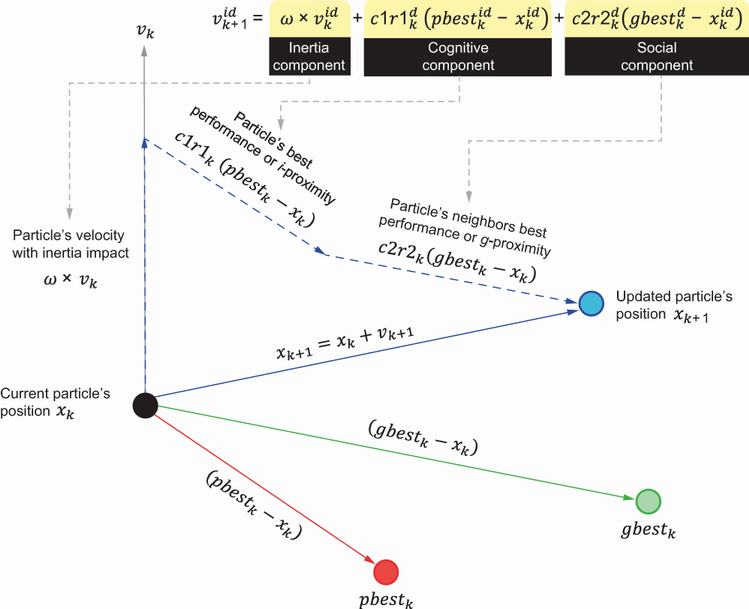
Visualizes how the cognitive, social, and inertia components combine in a particle’s motion update. section 9.2.1
Figure 9.13 Cognitive and social acceleration coefficient updates. c1>c2 results in more exploration, while c2>c1 may lead to more exploitation.
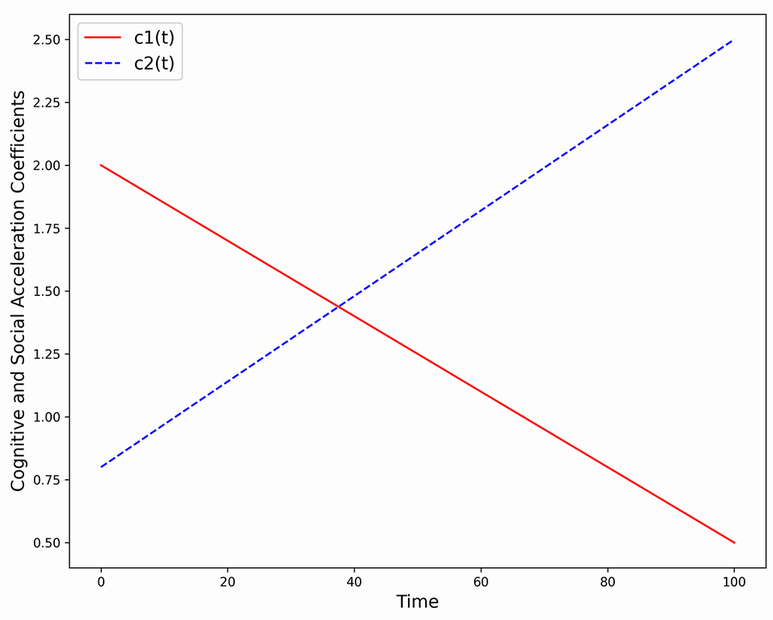
Shows cognitive and social coefficients shifting from exploration toward exploitation over iterations. section 9.5.2

