Cohesion is the degree to which concepts, events, rules, and activities belong together as a coherent subdomain. Strong cohesion clarifies purpose, reduces dependencies, aligns teams, and supports faster, more sustainable change. section 9.1
Loyalty levels in a travel business
A loyalty-levels feature changes loyalty accounts, loyalty points, and rewards. Modeling these concepts within one cohesive subdomain lets one team change one codebase, while separate placement would require coordination across three teams and codebases. The shared purpose—rewarding loyalty to increase customer lifetime value—also gives the team a durable direction for evolution. section 9.1
Analyze a candidate subdomain by asking:
- Does each event fit the subdomain’s name and purpose? section 9.4.5
- Are the events related to one another? section 9.4.5
- Could one team own all the events, and do business rules or features require the concepts to change together? section 9.4.5
- Mark events that feel out of place with a question mark, then explore whether they belong in another subdomain. section 9.4.5
Refining accounting boundaries
An accounting modernization effort tested several boundary designs using concrete scenarios. Refinement moved from four fine-grained boundaries to two larger ones, increasing cohesion and reducing overall complexity. Real use cases exposed dependencies, design smells, and a clearer separation between fixed-asset responsibilities and computing tasks. section 12.2.3
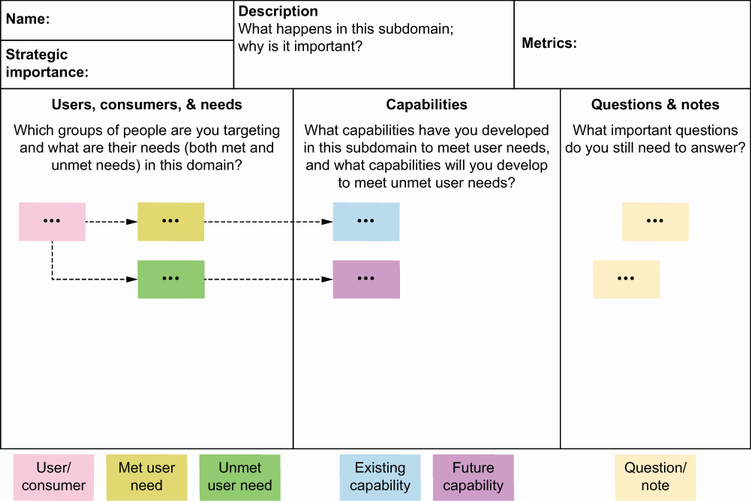
Use the subdomain overview canvas to visualize each candidate subdomain’s purpose, concepts, events, and boundary options during collaborative analysis. section 9.4.5



