A new item enters a search index, but nobody has interacted with it yet. A behavior-based recommender has no evidence that anyone likes it or that it resembles items they like. With no signals, the item may never be recommended; with only a few, its matches may be poor. This is the cold start problem. section 9.2.2
Collaborative filtering learns from patterns of user interactions rather than item content. That makes it useful even when content attributes are incomplete, but it also creates a catch-22: an unseen item needs exposure to earn signals, while a signals-dependent system may withhold that exposure. Boosting already-popular items can reinforce the cycle and reduce result diversity. section 4.2.3 section 9.2.2
Figure 4.6 Collaborative filtering for user-to-item recommendations. Based upon his past behavior, our user (Alonzo) receives recommendations based on items other users liked, where those users also interacted with some of the same items as Alonzo.
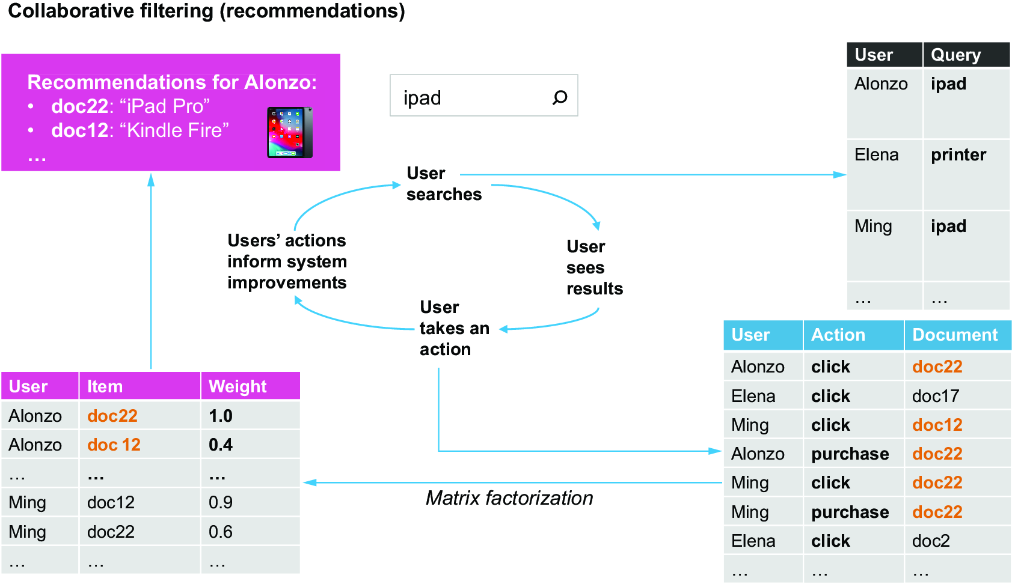
The recommendation path depends on overlapping interactions between users and items. A new item with no interactions has no such path in this example. section 4.2.3
Handle missing behavioral evidence according to what is new:
- New user: without prior item interactions, fall back to non-personalized search results. section 9.5
- New or sparsely observed item: combine collaborative filtering with content-based search or attribute matching, so recommendations need not rely solely on interaction history. section 9.2.2 section 9.5
Learning to rank offers another route for ranking documents, using relevance judgments rather than requiring every document to have interaction signals. Whichever route is used, personalization should remain relevant to the current query rather than overpowering it. section 4.3 section 9.5




