When estimating whether side-quest engagement increases in-game purchases, controlling for every available predictor can create bias rather than remove it. Collider bias arises when conditioning on a collider—or one of its descendants—opens an association between the collider’s causes. section 11.4.1 section 4.1.1
In a graph such as In-Game Purchases → Total Inventory ← Won Items, Total Inventory is a collider. The two causes need not be associated beforehand, but conditioning on Total Inventory can make them statistically dependent and distort a causal estimate. section 11.2 section 4.1.1
Concrete conditioning effects
Rain and a sprinkler can be independent, yet become dependent after conditioning on wet grass: if the sprinkler is off, wet grass makes rain more likely. Similarly, knowing a child’s blood type can make the mother’s and father’s blood types informative about one another. section 4.1.1 section 4.1.1
Use the causal graph to avoid collider bias during adjustment:
- Do not automatically control for every covariate; first determine whether it is a confounder, mediator, or collider. section 11.4.1
- Treat adjustment for a collider as opening an unwanted path rather than blocking a confounding path. section 11.4.1
- Use a valid backdoor adjustment set instead of an indiscriminate set of observed variables. section 11.4.1
Figure 11.2 An expanded version of the online gaming DAG. With respect to the causal effect of side-quest engagement on in-game purchases, we add two additional confounders and two instruments.
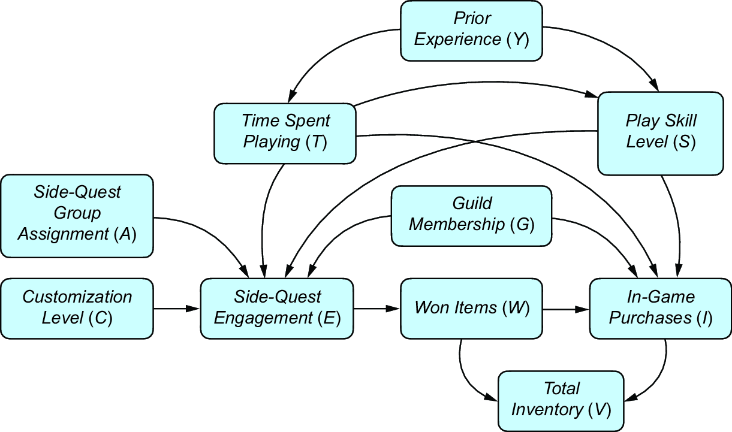
Inspect the expanded gaming DAG to trace collider structures, confounders, instruments, and the variables that should be excluded from adjustment. section 11.2
