A collision domain is a network segment where simultaneous transmissions can interfere and produce collisions. Only one host can transmit at a time without collisions. section 8.1.3
The device connecting hosts determines how the collision domain behaves:
- Hub: places every connected host in one shared collision domain. Because a hub repeats signals without buffering frames, simultaneous transmissions become corrupted, so connected devices use half duplex. section 8.1.3
- Switch: places each connected host in its own collision domain. Frame buffering and forwarding let hosts transmit and receive simultaneously using full duplex. section 8.1.3
- Half-duplex devices use CSMA/CD to detect and handle collisions; duplex settings can be automatic, full, or half. section 8.4
Figure 8.2 Four PCs are connected to a hub, and two attempt to transmit at the same time, resulting in collisions. All four PCs are in the same collision domain. (1) PC2 sends a frame addressed to PC1’s MAC address, and PC4 sends a frame addressed to PC3’s MAC address. (2) The hub attempts to flood both frames at the same time, resulting in collisions. Neither PC1 nor PC3 receive their respective frames intact.
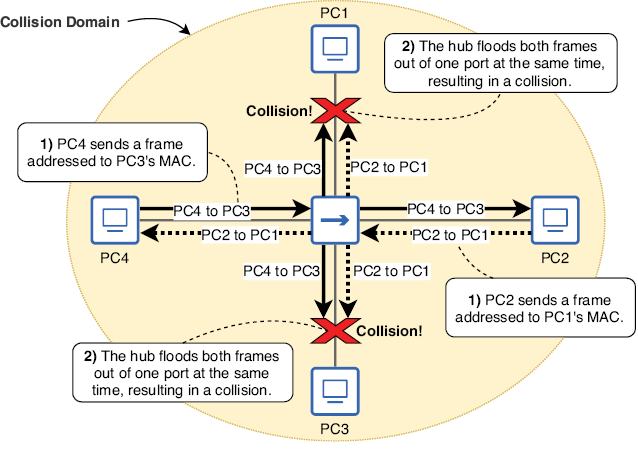
Shows two PCs transmitting through a hub at the same time, producing collisions that prevent the intended frames from arriving intact. section 8.1.3
Figure 8.3 Four PCs are connected to a switch, each in its own collision domain. (1) PC2 and PC4 each send a broadcast frame at the same time. (2) The switch floods the frames, but it does not flood PC2’s frame to PC1 or PC3; it buffers the frame in memory. (3) The switch floods PC2’s frame to PC1 and PC3 after it has finished flooding PC4’s frame.
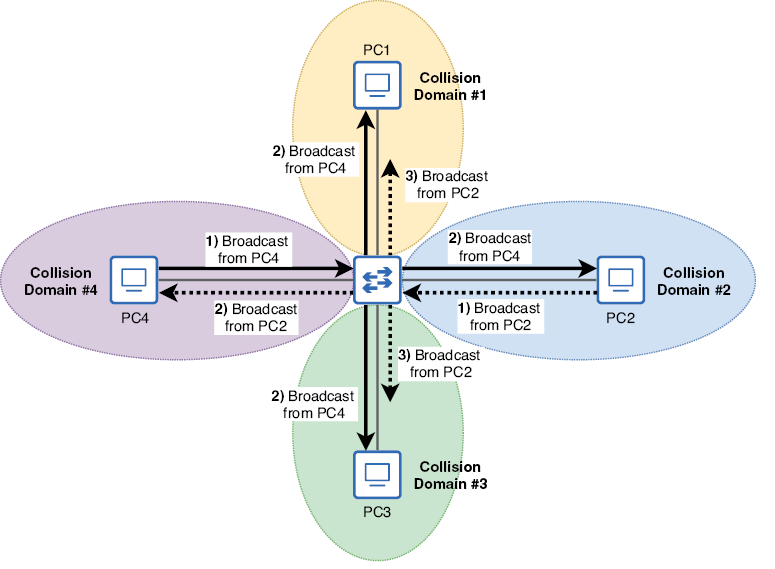
Shows four switched PCs in separate collision domains and illustrates how buffering prevents simultaneous frames from colliding. section 8.1.3
