liveBook · Manning

Column constraint

As explained in Quantum Programming in Depth

A column constraint is the N queens condition that each board column contains exactly one queen.

The column constraint requires an N queens placement to contain exactly one queen in every board column. With one queen already encoded per row, the oracle checks column occupancy alongside diagonal safety. section 8.3.1 section 8.2.2

In the Qiskit implementation, column checks accumulate queen indicators into validation qubits with controlled operations. A separate Python validator extracts each row’s queen column and rejects duplicate column indices. section 8.2.2 section 8.2.2

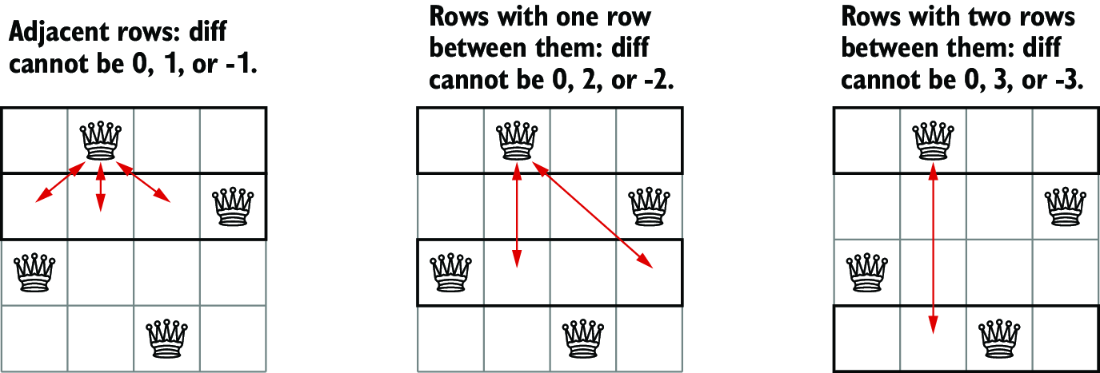
Figure 8.8 To check that no two queens share a column or a diagonal, we need to check each pair of rows separately. For each pair of rows, we calculate the difference of the indices of queens within them. This difference cannot be equal to zero or to the difference between the indices of these rows.
figure

Compare each pair of rows by subtracting their queen-column indices; a zero difference identifies a shared column, while the row-distance comparison handles diagonal conflicts. section 8.3.1

How Quantum Programming in Depth covers it

How deep it goes
Implements column validation with auxiliary qubits and controlled operations, while row uniqueness comes from the input encoding.
Examples
Demonstrates column checking through pairwise index differences, Qiskit oracle code, and a Python placement validator.
What it assumes
Assumes one queen per row and represents each row’s queen by its column index.
What you can do after
Diagnoses candidate placements with a Python validator that rejects equal queen-column indices.
How it connects
Connects N queens, row encoding, Grover’s algorithm, quantum oracles, and reversible computation.

Related concepts

This explainer was generated by Manning's knowledge graph from the text of Quantum Programming in Depth. The section links point to the parts of the book it draws on.