Column-major order stores a matrix one column at a time. Elements in a column are adjacent in memory, so moving down a column advances by one position; moving across a row skips over the other rows. section 5.1
For a matrix with M rows and N columns:
- The element at row i, column j has flat offset j × M + i. In row-major order, the corresponding offset is i × N + j. section 5.1
- The logical matrix does not change between layouts; only the physical address of each element changes. Strides describe this mapping and can let a transposed view use the same storage. section 5.1 section 5.2.2
- For GPU kernels, neighboring lanes requesting consecutive addresses can use memory transactions efficiently; strided accesses may transfer more unused data. section 5.10
A 3 × 4 matrix
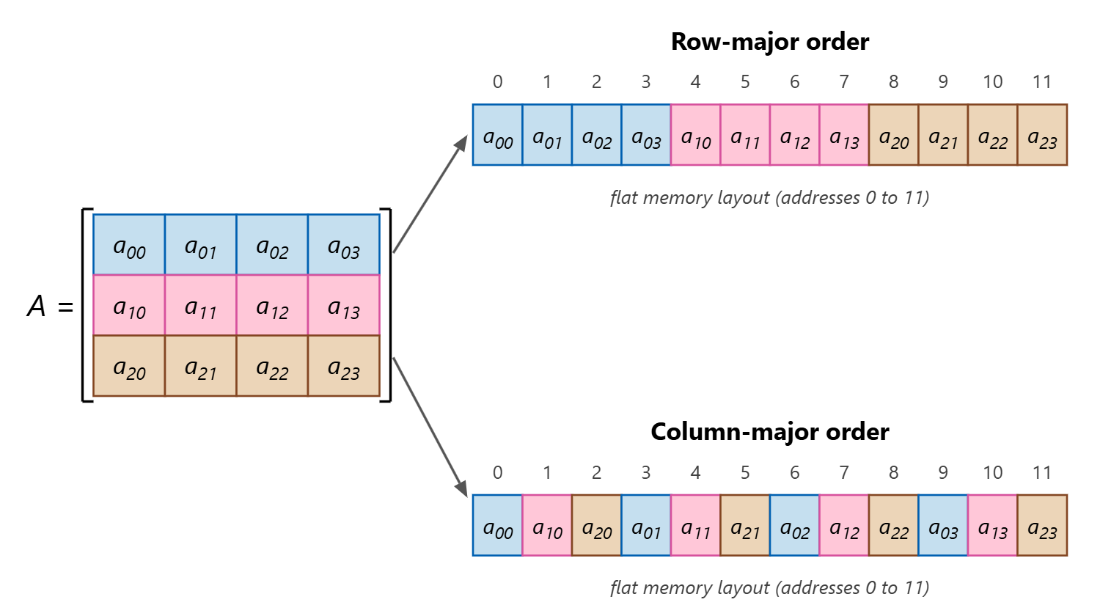
Column-major storage lists [a00, a10, a20, a01, a11, a21, a02, a12, a22, a03, a13, a23]. Thus a21, at row 2 and column 1, has offset 1 × 3 + 2 = 5. section 5.1
Figure 5.1 Row-major versus column-major memory layout. In row-major order (top), elements in the same row are adjacent in memory. In column-major order (bottom), elements in the same column are adjacent.
Compare which matrix direction is contiguous in each layout. section 5.1