A columnstore index stores collections of column values on pages rather than collections of complete rows. It compresses column values and divides the index into segments, making it suited to analytical queries that read large sets of data rather than individual rows. section 11.11
Mistake #77: treating every index as a B-tree. Traditional indexes organize rows through a B-tree structure; a columnstore pivots that layout around columns. Each segment holds 102,400 to 1,048,576 rows and carries metadata that can let the query engine skip segments unrelated to a query. section 11.11
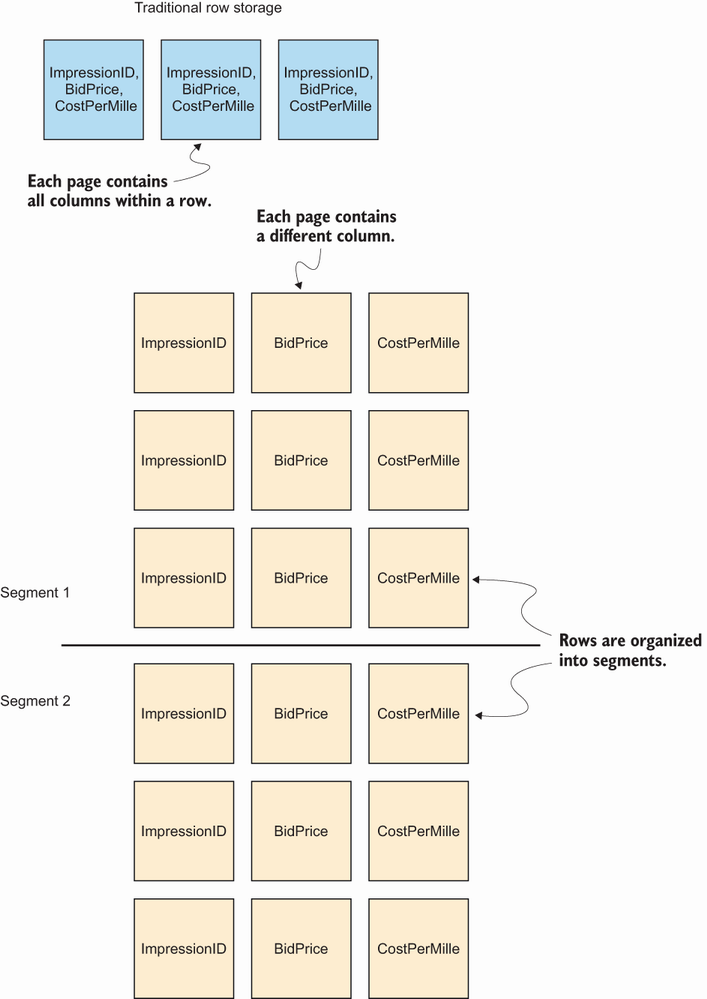
Compare the row-oriented and column-oriented layouts before choosing an index strategy. section 11.11
Archive-table aggregate
An aggregate over dbo.ImpressionsArchive, such as AVG(BidPrice) and AVG(CostPerMille), represents the analytical workload where a columnstore index can offer major gains. Create a clustered columnstore index on the archive table, then measure the query rather than assuming the result. CREATE CLUSTERED COLUMNSTORE INDEX ImpressionsArchiveCCSI ON dbo.ImpressionsArchive; section 11.11
Use this practical rule set:
- Consider a columnstore index for large fact tables and data warehouse-style analytical queries. section 11.12
- Use segment metadata as the reason it can avoid reading irrelevant portions of large data sets. section 11.11
- Keep workload fit central: columnstore indexes are presented as an underused analytical option, not merely as another conventional B-tree index. section 11.11
- Add a nonclustered B-tree index separately when the table design calls for both index types. section 11.11
