Comment-driven generation turns reviewer feedback into targeted revision guidance. Anchor each comment to selected content, then batch related comments so they remain in context. Use it to improve specific passages, not to request a full rewrite. section 4.9
A practical workflow:
- Select the passage that needs work and attach a specific comment explaining the gap. section 4.9
- Generate a recommendation for each comment, keeping it tied to the original passage and naming what is missing. section 4.9.1
- Optionally use inversion to generate recommendations, then use refinement to implement them in the draft. section 4.9
Technical RFC review
For a rate-limiting proposal, comments can flag a claim lacking evidence, an unspecified technical approach, and an unclear implementation scope. Turn these into requests for operational metrics, the algorithm and enforcement layer, affected endpoints and thresholds, and rollout, monitoring, and rollback criteria. The RFC is improved when these recommendations become concrete changes. section 4.9.1
Specific comments produce actionable guidance; vague feedback such as “this needs work” tends to produce generic suggestions. The same approach can organize code reviews, security findings, and performance analysis. section 4.9 section 4.9.1
Figure 4.3 Comment-driven generation workflow from anchored feedback to updated draft
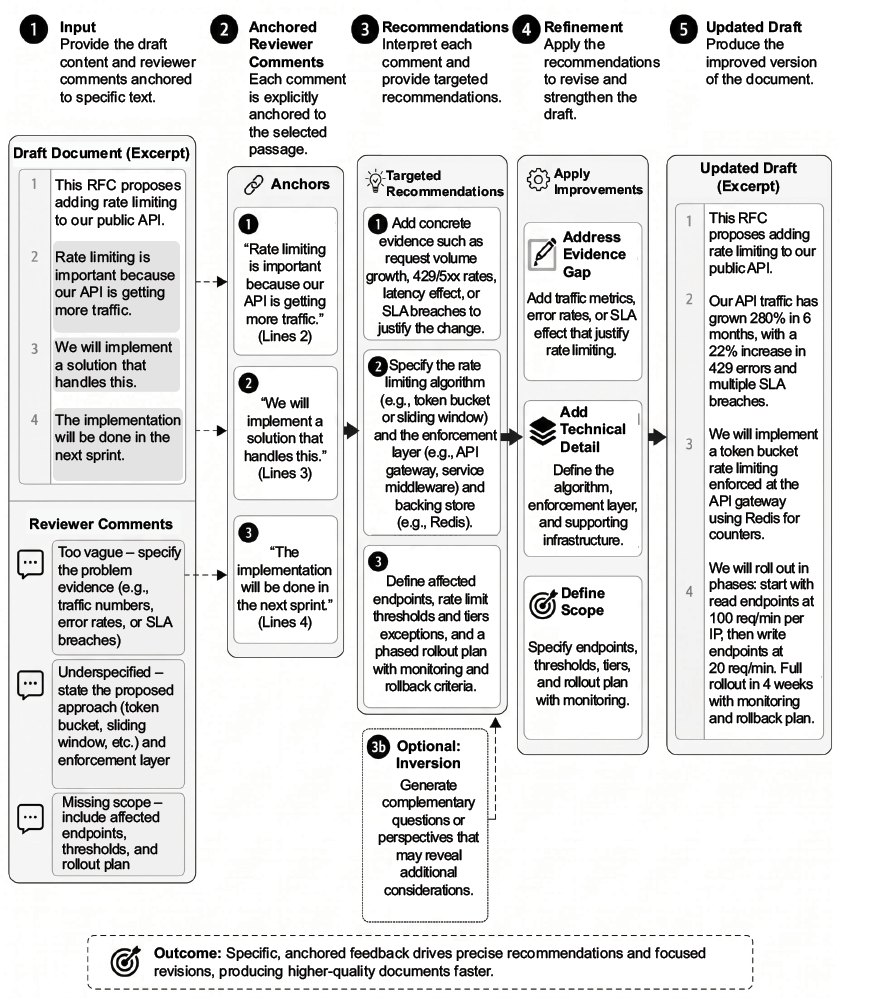
Follow the flow from anchored feedback through recommendations to an updated draft. section 4.9
