A commercial model is a generative AI or language model distributed or operated through proprietary commercial terms, commonly accessed as a cloud API. Commercial models generally emphasize strong performance and broad capabilities, while open-source models emphasize customization and integration flexibility. section 2.7 section 2.9
Enterprise adoption commonly involves:
- Selecting a hosted model for use cases such as summarization, classification, question answering, content generation, translation, analysis, or process automation. section 2.9
- Integrating the provider API into existing architecture rather than treating the model endpoint as a standalone system. section 1.7
- Planning for latency, nondeterministic output, retries with exponential backoff, caching, security, token-based costs, and failure. section 1.7
- Applying governance and ethics controls to misuse, hallucinations, incorrect details, and automated tasks previously performed by people. section 1.7
Provider choices
OpenAI exposes models such as GPT-4, DALL·E, and ChatGPT; Azure OpenAI provides managed Azure infrastructure around OpenAI models; Anthropic offers Claude; Google offers Gemini through Google Cloud and Google AI Studio; and Cohere offers language and embedding products. section 2.7.1
Figure 2.2 Timeline of LLMs with 10+B parameters: A Survey of LLMs
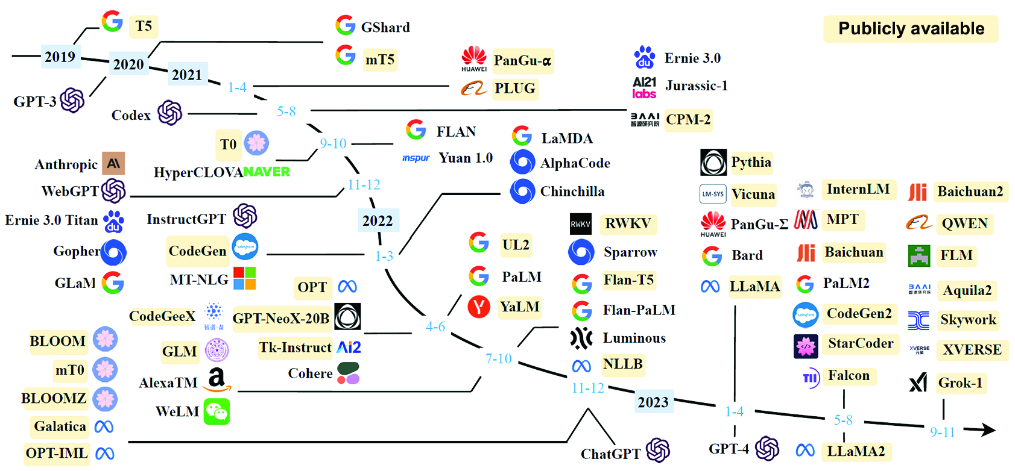
Use the timeline to compare the rapid development of large language models with at least 10 billion parameters and the parallel growth of commercial and open-source lineages. section 2.7
