liveBook · Manning

Communication pattern

As explained in Microservices Patterns, Second Edition

A pattern category for implementing inter-process and client-to-service communication in a distributed application.

Communication patterns provide the mechanisms for services in a microservice architecture to collaborate and for clients to communicate with those services. section 7.6.2

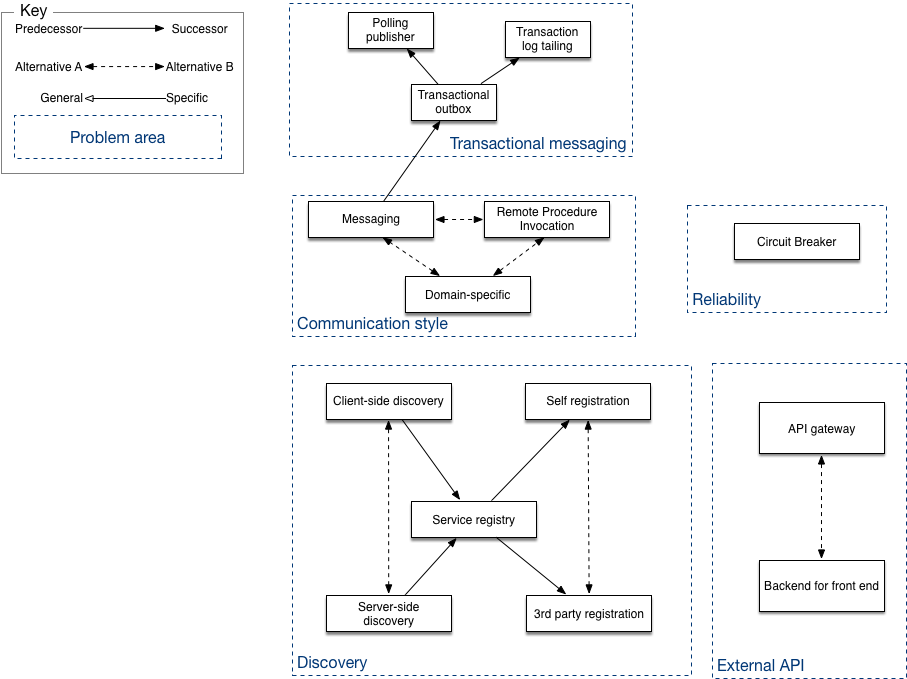
The pattern category groups decisions into five areas:

  • Communication style: choose synchronous IPC, such as RPC or REST, or asynchronous messaging. section 7.6.2
  • Transactional messaging: integrate message sending and receiving with business-data transactions. section 7.6.2
  • Reliability: address unavailable services and network problems in synchronous communication. section 7.6.2
  • Discovery: let a client find a service instance’s network address. section 7.6.2
  • External API: define how clients outside the application communicate with its services. section 7.6.2
Figure 7.13 The five groups of communication patterns that underlie the service collaboration and enable an application’s clients to communicate with its services.
communication

Use the overview to see how the five communication-pattern groups support service collaboration and client access. section 7.6.2


How Microservices Patterns, Second Edition covers it

How deep it goes
Organizes communication concerns into five groups and names IPC options, without detailing their implementations.
Examples
Names RPC and REST as synchronous options and asynchronous messaging as an alternative.
What you can do after
Understand the communication concerns that service collaboration and client access must address.
How it connects
Connects microservice architecture, service collaboration, inter-process communication, RPC, REST, and asynchronous messaging.

Also explained in

Compare how 3 books explain communication pattern →

Related concepts

This explainer was generated by Manning's knowledge graph from the text of Microservices Patterns, Second Edition. The section links point to the parts of the book it draws on.
