Compile time is the phase when source code is analyzed and transformed into an executable or library artifact. Rust macros run here, expanding into ordinary structs, functions, and related code before linting, type checking with cargo check, library compilation, or binary generation by rustc. section 1.2
Treat compile-time generation as a practical trade-off:
- Use macros to reduce boilerplate or duplication only when the resulting code remains understandable. section 1.3.2
- Prefer structs, enums, functions, generic functions, or blanket implementations when they express the solution more clearly. section 1.3.2
- Account for increased compile times and binary size; small macros may impose negligible cost, while production-grade macros can create a significant trade-off. section 1.3.2
Generated code hidden behind a simple example
A concise Rust program can conceal many lines generated by macros. After expansion, those lines become ordinary code that proceeds through linting, type checking, and compilation. section 1.2
Figure 1.1 I contain multitudes! How our simple example hides many more lines of code, generated by macros.
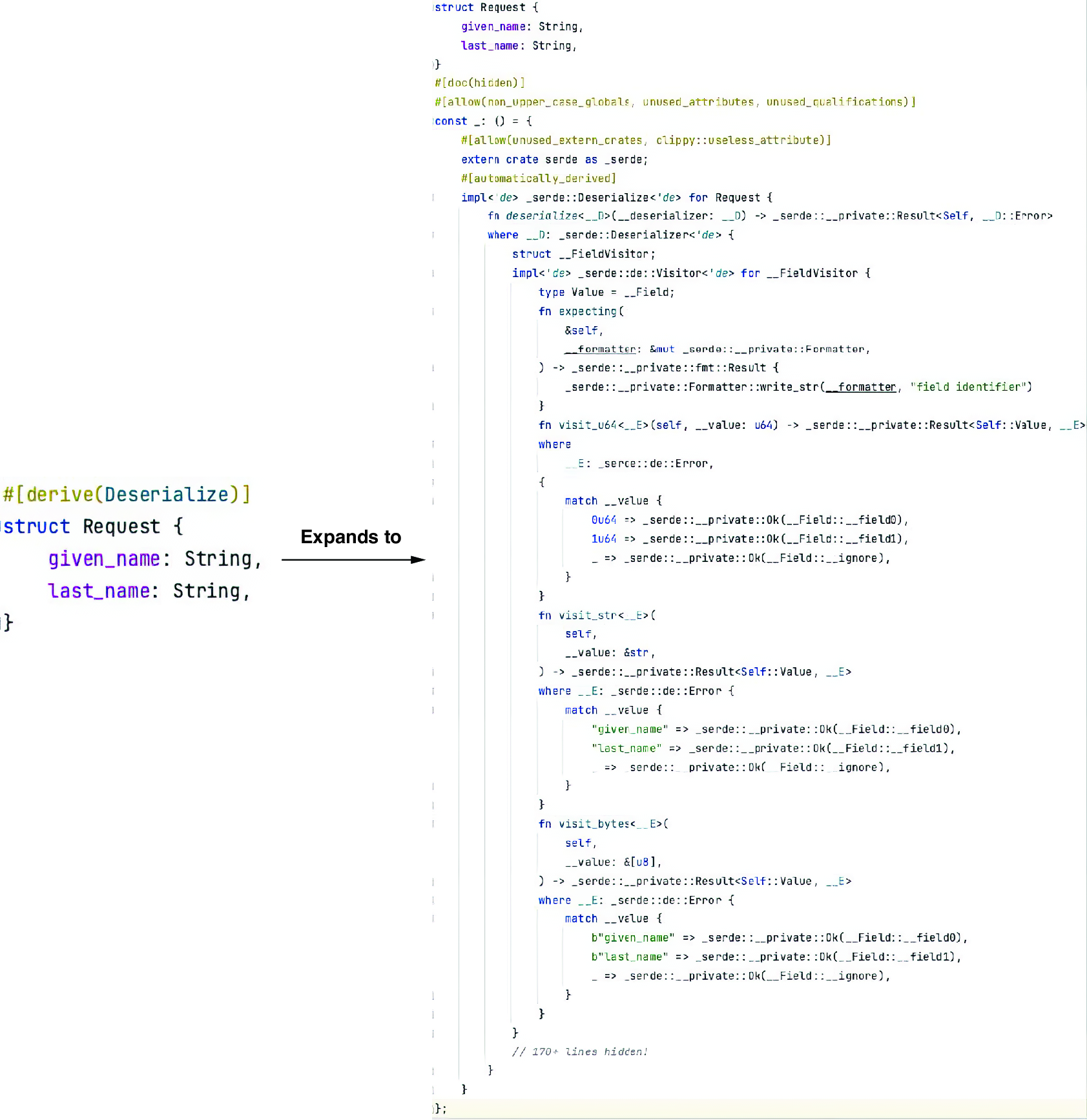
Visualizes how a small example can contain substantially more macro-generated code before later compilation stages. section 1.2

