The complex plane represents complex-number behavior geometrically and supplies a visual bridge from elliptic curves over real numbers to elliptic curves over finite fields. Its two independent directions help explain repeating structures that later appear in field-extension curves and pairings. section 3.1.2 section 3.0
The geometric picture connects several elliptic-curve mechanisms:
- Periodic behavior wraps the complex plane into a torus, with two independent vectors marking a nonrepeating region. section 3.1.2
- A repeating grid on the torus corresponds to a finite field, making finite-field arithmetic visually comparable to complex-plane geometry. section 3.1.2
- The two directions represent two cyclic groups; a single-cycle base curve contrasts with the double cyclic structure needed for pairings. section 3.1.2 section 15.1
From curve to finite-field grid
Imagine an elliptic curve repeating along two vectors. Selecting the rectangle where values do not repeat produces a grid whose point spacing divides both vectors exactly, giving the mental model for a finite field. section 3.1.2
Figure 3.2 Elliptic curve over the complex plane
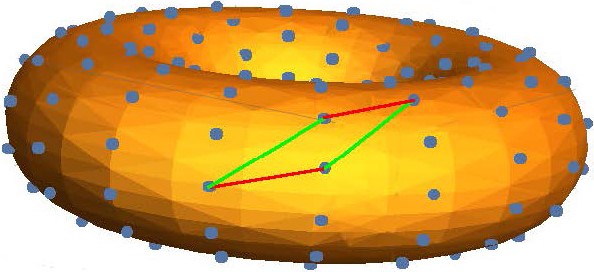
Use the figure to visualize an elliptic curve drawn over the complex plane and its periodic directions. section 3.1.2
Figure 3.3 Points on a curve over a complex plane
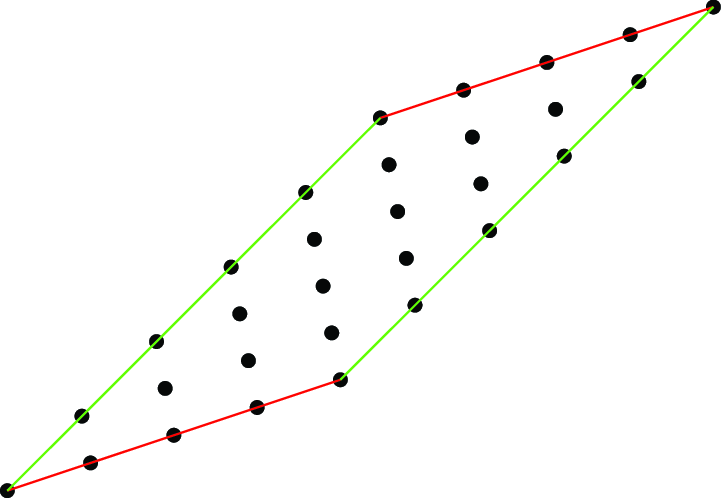
Use the zoomed view to inspect the repeating point grid associated with the torus and finite-field analogy. section 3.1.2
