liveBook · Manning

Component view

As explained in Microservices Patterns, Second Edition

An architectural view that represents an application as deployable components containing subdomains.

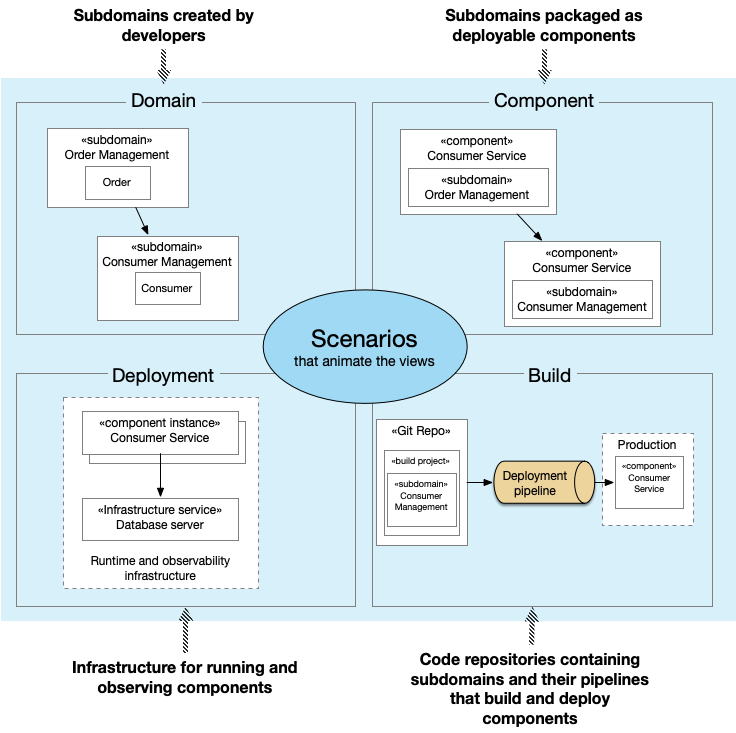
The component view describes how an application’s subdomains are organized into components, which are deployable units. It is a static view of the architecture, distinct from scenarios that describe dynamic behavior. section 3.2 section 3.5

The domain view identifies subdomains; the component view organizes them into deployable units. The deployment view describes the technologies that run those units, while the build view describes pipelines that package and deploy them. section 3.2 section 3.5

Deployment choices

Monolithic and microservice architectures illustrate different ways of organizing subdomains into components. section 3.2 section 3.5

Figure 3.5 My 4+1 view model, which uses four views (+ a scenario view) to describe an application’s architecture.
architecture dimensions

Use the view-model diagram to locate the component view among the architecture’s static views and its scenario view. section 3.2

How Microservices Patterns, Second Edition covers it

How deep it goes
Defines components as deployable units containing subdomains without detailing their internal design.
Examples
Contrasts monolithic and microservice architectures as component-organization examples.
What you can do after
Evaluate how subdomains are grouped into deployable components and distinguish this view from deployment and build concerns.
How it connects
Distinguishes the domain, deployment, and build views from the dynamic scenario view.

Related concepts

This explainer was generated by Manning's knowledge graph from the text of Microservices Patterns, Second Edition. The section links point to the parts of the book it draws on.