A concept is a blueprint for a fundamental construct in a domain-specific language (DSL). It has a name and properties; each property has a name and a type, and the type determines which values it can hold. section 1.4.2
A DSL author instantiates concepts to create DSL content. Each instance assigns property values through settings. Settings can also represent relations between instances, subject to the types of their properties. section 1.4.2 section 1.5
A car-rental DSL uses concepts to organize domain data:
- A business rule concept has condition and consequence properties. section 1.4.2
- A record type concept has name and attributes properties, grouping related data. section 1.4.2
- An attribute concept has name, type, and optional initial value properties. section 1.4.2
Changing a concept
Changing a DSL may add a property or concept, alter a property type, remove or rename an element, or refactor several concepts together. Non-widening changes require AST migration so existing content conforms to the new structure. section 10.3.2
Figure 1.20 Zooming in on the structure aspect of a DSL
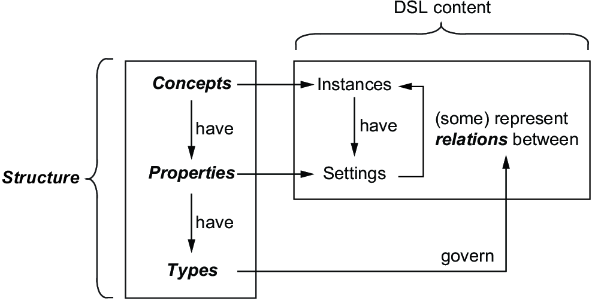
Use the structural overview to trace how concepts, properties, instances, settings, and relations fit together. section 1.4.2
