A prediction is not the product of an algorithm alone. The conceptual stack makes visible the layers of ideas and assumptions that shape how data becomes a result, how that result is evaluated, and how it is used. section 1.2
The five interacting layers are:
- Raw data and feature engineering section 1.2
- Modeling and decision frameworks section 1.2
- Algorithmic assumptions section 1.2
- Mathematical foundations section 1.2
- Epistemology and ethics section 1.2
The layers interact: each can shape data representation, problem framing, method behavior, or result interpretation. A performance metric captures only one aspect; confidence also depends on assumptions and choices across the stack. No single contribution accounts for an entire working system. section 1.2 section 1.3
When a system fails
A model that loses accuracy as its data changes, or produces biased predictions, calls for more than checking whether it ran successfully. Tracing the stack helps identify assumptions and constraints that may explain the result. section 1.0 section 1.5
Figure 1.1 The hidden stack of modern intelligence. Panel A shows the five layers that shape how learning systems are built, evaluated, and used. Panel B lists the book’s foundational works in chronological order from top to bottom. Filled circles show the multiple layers informed by each contribution.
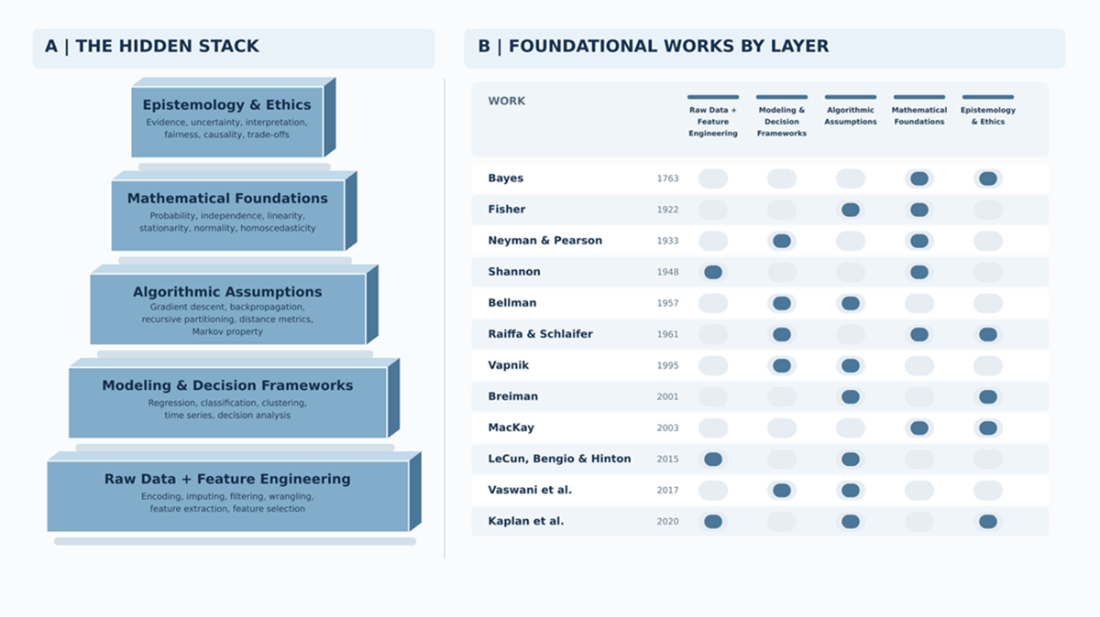
The diagram maps five system layers alongside foundational contributions, showing that a contribution may inform multiple layers. section 1.2
