Concrete syntax is the notation of a domain-specific language (DSL): the textual or visual form in which its content is presented. Its details may include keywords, symbols, indentation, boxes, arrows, and other visual markers. section 2.2 section 2.3
Extracting visual cues from concrete syntax reduces notated content to structured data called abstract syntax. An object-relation diagram (ORD) can represent that structure, and disregarding reference relations allows it to become an abstract syntax tree (AST). section 2.2 section 2.3
Read concrete syntax by identifying the cues that carry structure:
- Recognize the whole construct, such as a record type and its name. section 2.2
- Use keywords, symbols, indentation, boxes, and arrows to find contained elements and relationships. section 2.2
- Represent names, types, numbers, and references as properties or relations in structured data. section 2.2
Rental record type
A concrete DSL description defines a Rental record type with four indented attributes. Extraction first represents the record type, then adds its name, attribute objects, containment relations, attribute names and types, numeric initial values, and reference values. section 2.2
Figure 2.8 The DSL content defining the Rental record type
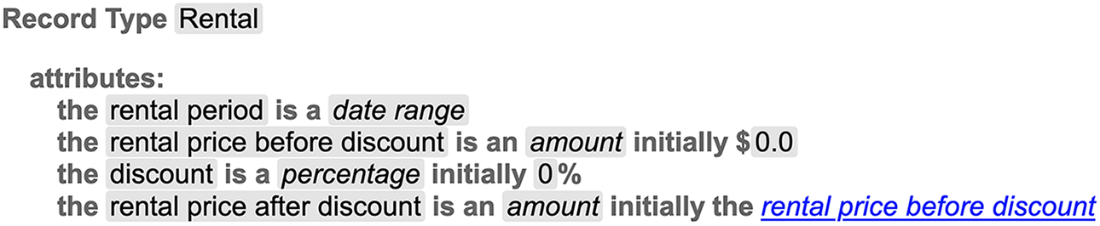
Inspect the notated Rental record type that supplies the concrete syntax for the extraction example. section 2.2
