Conditional generation produces structures guided by specified information or constraints. In drug design, a model can learn the joint distribution of molecular structures and properties, then generate molecules conditioned on desired property values. section 13.2.1
Designing molecules with constraints
MolMIM can generate molecules with a required scaffold—a core molecular structure—and specified property ranges. For example, a design could require a target-binding scaffold, molecular weight of 300–450 Daltons, predicted logP of 2–4, and at most one chiral center. Multiple objectives help balance potency against molecular weight and lipophilicity. section 13.2.1
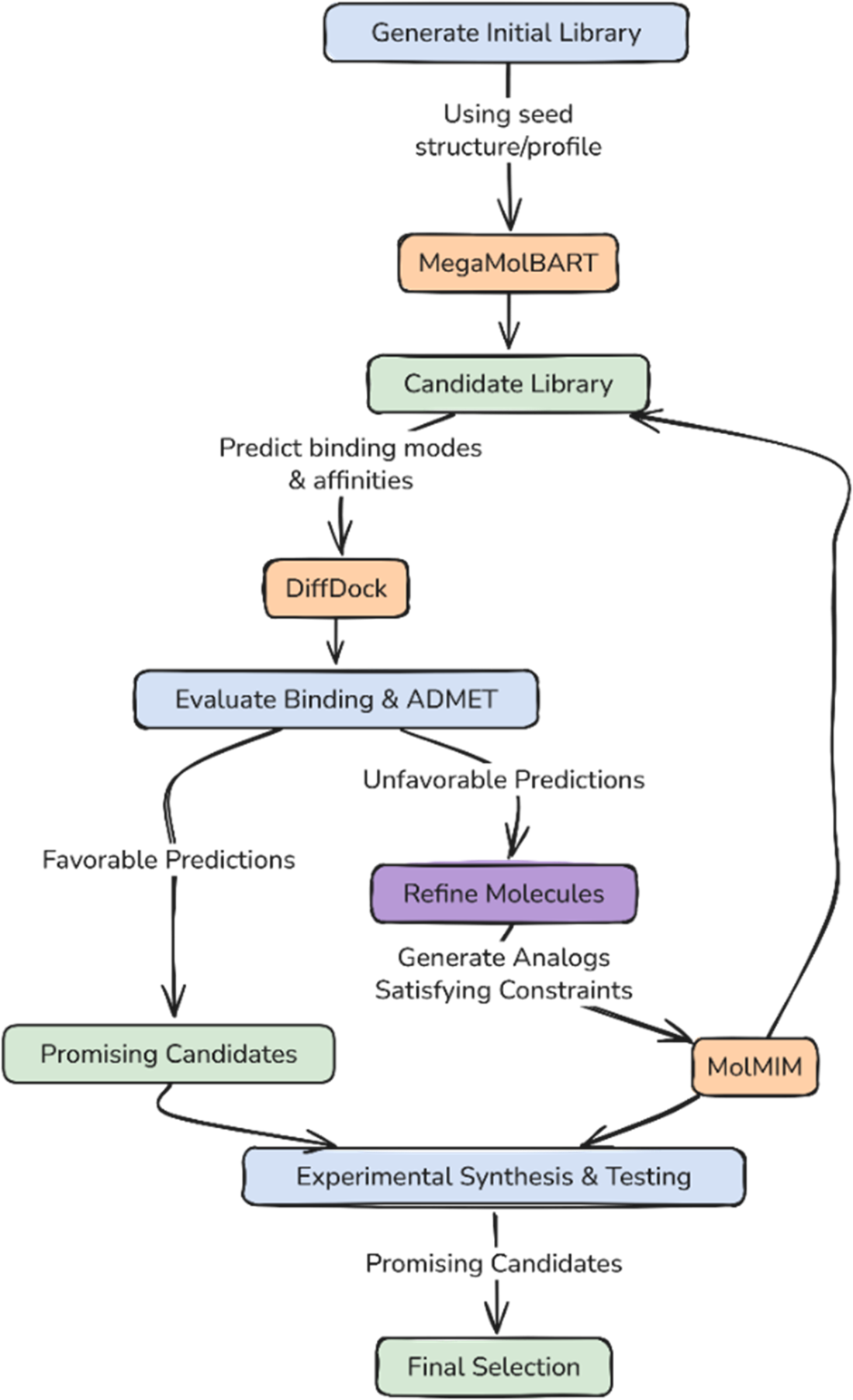
In an iterative workflow, MegaMolBART generates candidates and DiffDock predicts their binding poses and confidence scores, not binding affinities. Candidates with unfavorable predictions or poor predicted ADMET properties can be redesigned with MolMIM and evaluated again before experimental testing. section 13.2.1
Figure 13.3 A modular AI-driven drug discovery pipeline with dual feedback loops for candidate optimization. The workflow architecture features two iterative refinement paths: unfavorable predictions trigger molecular redesign through MolMIM before reevaluation, while favorable predictions advance to a candidate pool that feeds back for further optimization. Rather than static processes, think of blueprints from the framing of a “whiteboard” design where, as simply as one erases and redraws on a whiteboard, researchers can swap components (e.g., alternative docking tools or generative models) and adjust decision thresholds, enabling rapid experimentation with different AI tool combinations before committing computational resources to full-scale screening or wet-lab validation.
Explore how molecular redesign and reevaluation fit into an iterative drug-discovery workflow. section 13.2.1
