A confidence threshold is a cutoff for deciding when to trust an annotation or model prediction. Setting it requires balancing annotation accuracy against the cost of additional review and the risk of excluding difficult, nonrandom examples. section 8.3.5 section 9.3.1
For annotations, first choose a confidence measure. It can use the highest label probability, the difference between competing labels, or the full probability distribution. Compare the measure against ground-truth data to find a cutoff that meets the desired accuracy. If using uncertainty instead of confidence, trust items below the uncertainty cutoff rather than above it. section 8.3.5
Choosing an annotation cutoff
For one set of annotations, ground-truth comparisons indicate that trusting items with agreement uncertainty below about 0.65 achieves approximately 0.96 annotation accuracy. The cutoff applies to that uncertainty measure and evaluation data; it is not a universal threshold. section 8.3.5
When an annotation falls below the confidence threshold, possible actions include:
- Send it to another annotator and recalculate confidence. section 8.3.5
- Ask an expert annotator to adjudicate the correct label. section 8.3.5
- Exclude it, if review is impractical. This wastes prior effort and risks bias because difficult tasks are unlikely to be random. section 8.3.5
A model can also supply labels for predictions above a confidence threshold. Human review can help tune the cutoff. Per-label thresholds, or selecting the top N predictions per label, can prevent easy-to-predict labels from dominating. Confident predictions alone may amplify bias or miss novel cases, so combine them with active learning for more representative data. section 9.3.1
A detection threshold serves a different purpose when selecting candidates for object detection: keep it low to avoid finding only objects similar to those already in the data. A low cutoff can produce many false positives, so sample across confidence bands rather than simply raising it. Reviewing non-objects can also help the model learn what not to detect. section 6.1.5
Figure 6.5 Stratifying by confidence: sampling an equal number of items at 0–10% confidence, 10–20% confidence, and so on up to 90–100% confidence. In this example, one item is sampled from each 10% confidence interval for label A. Stratifying by confidence helps most when you have a large number imbalance between labels.
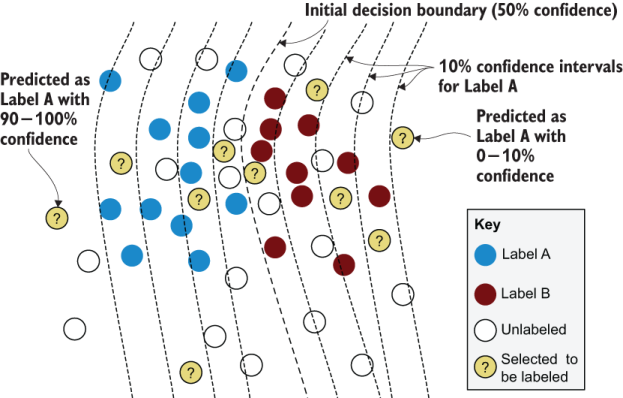
The figure illustrates sampling equal numbers from confidence intervals, preserving lower-confidence candidates without reviewing them all. section 6.1.5