Configuration drift is the gradual mismatch between a system’s actual settings and its intended setup—or between environments meant to match. Manual changes, especially live-server patches and repeated cloud-console clicks, can turn one server into a snowflake and staging into a surprise version of production. section 9.2 section 9.6.1
The forgotten click
Imagine creating 100 servers by hand. One gets the wrong memory tier; another misses an environment variable. Later, staging and production no longer match, and a click-by-click guide may be outdated. A live security patch creates the same risk: the server now differs from the repeatable configuration. section 9.6.1 section 9.8.2
Reduce drift by treating application servers as replaceable, not as machines to edit in place:
- Update the infrastructure definition or Dockerfile, build a fresh patched server, verify it, route traffic to it, then destroy the old server. section 9.8.2
- A blue-green deployment keeps the old environment available while the new one is checked, so traffic can switch back if the release fails. section 9.8.2
Figure 9.6 The Immutable Deployment Pipeline. Instead of patching live servers, we build a fresh Server Image from our code, deploy a new instance, automatically verify its health, seamlessly swap the user traffic at the Load Balancer, and finally destroy the old infrastructure.
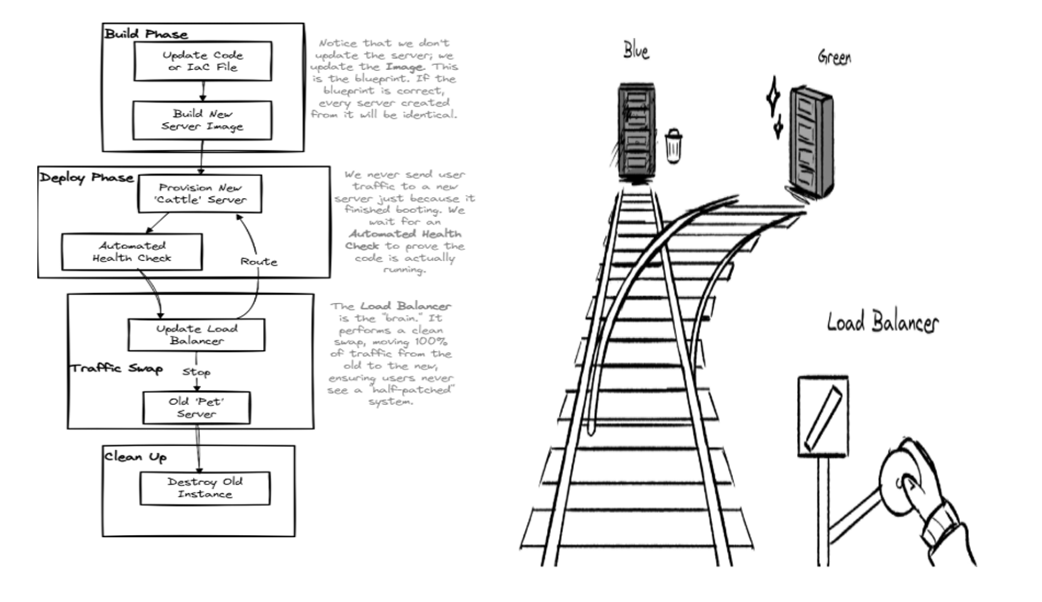
Follow the pipeline from a server image built from code through health checks, traffic switching, and destruction of the old infrastructure. section 9.8.2
Immutability makes application servers predictable and rollbacks simpler, but it is not a license to destroy state: production databases need careful, persistent changes to protect their data. section 9.8.3

