A connected graph lets you travel between every pair of vertices along a sequence of edges. Equivalently, every vertex has a path to every other vertex. section 14.2.2
Use these properties to distinguish connected graphs from related structures:
- A connected graph with |V| vertices must contain at least |V|-1 edges. section 14.2.2 section 14.1.1
- A tree is a simple, undirected, connected, and acyclic graph, so connectivity is one of its defining restrictions. section 14.2
- For directed graphs, strong connectivity is the more precise related notion: every vertex must be reachable from every other vertex. section 14.2.2
- Choose adjacency lists for sparse connected graphs and adjacency matrices when density makes matrix operations more practical. section 14.1.1
Connectivity as a planarity prerequisite
A simple connected graph with at least three vertices can be planar only if |E| ≤ 3|V| - 6. Checking this bound takes O(|V|+|E|); violating it immediately rules out planarity. section 15.2.2
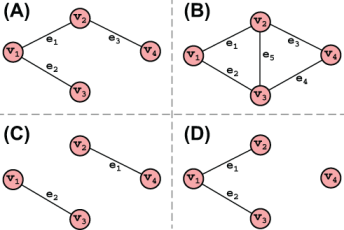
Compare connected and disconnected undirected graph shapes to make the path-between-vertices requirement concrete. section 14.2.2

