Connection pooling keeps reusable network connections under a long-lived manager instead of establishing a new connection for every operation. Reuse avoids the network latency and handshakes of reconnecting, while the manager selects, opens, and closes connections as needed. section 10.1 section 10.1.2
In Go’s database/sql API, sql.Open verifies a registered driver and returns a *sql.DB whose pool may initially be empty. Calling PingContext verifies connectivity and, on success, adds the first connection; retain the resulting *DB for the program lifetime rather than reopening it per query. section 10.1.2
Open and verify a SQLite pool
Use sql.Open("sqlite", dsn) to create the *sql.DB handle, then call db.PingContext(ctx). Wrap either failure with context such as "opening" or "pinging" before returning the handle for later queries. section 10.1.2
A pool tracks idle and in-use connections. For a database task, it uses an idle connection when available; otherwise it establishes one. Tune capacity with SetMaxOpenConns and SetMaxIdleConns, and bound reuse with SetConnMaxLifetime and SetConnMaxIdleTime. section 10.1.2
The same reuse principle applies to HTTP: http.Transport is a RoundTripper with a TCP connection pool. Reuse one Transport while sending requests, whether it is the default transport or a selected implementation behind http.Client. section 7.4.1
Figure 10.2 Connecting to the SQLite database using Open and PingContext
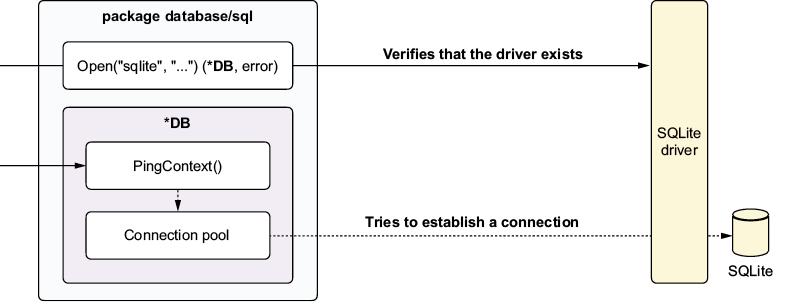
Trace the transition from an empty *sql.DB pool after Open to its first reusable connection after PingContext succeeds. section 10.1.2








